
Common linnet
Linaria cannabina
A small seed-eating songbird of open habitats, often forming flocks outside breeding season.
Type
Bird
Lifespan
3 years
Hunting season
October – January
Edible
Yes
Fact sheet
Common linnet
Scientific name
Linaria cannabina
Type
Bird
Meat quality
Firm and tasty meat
Edible
Yes
Lifespan
3 years
Incubation
14 days
Size
13-14 cm
Weight
20-25 g
Diet
Seeds and buds
Status
Huntable locally
Hunting season
October – January
Breeding season
5 / 6
Lifestyle and behaviour
Behaviour : Partial migrant, active, small flocks
Social structure : Small flocks outside breeding season
Migration : Partial migrant
Habitat
- Forest
- Shrubland
Natural predators
- Birds of prey
- Wild cat
- Mustelids
Hunting methods
- Standing post
Health risks
- Avian parasites
- Respiratory diseases
Ecosystem role
- Seed dispersal
Introduction
General description
The Common linnet, Linaria cannabina, is a small finch of open country, farmland margins, scrub, and coastal or lowland mosaics where seed-bearing plants remain available through much of the year. Best known for its light, bouncing flight and lively twittering calls, it is often encountered in pairs during the breeding season and in small to sometimes larger flocks outside it. Although discreet at a distance, the species is a classic bird of hedgerows, rough ground, weedy fields, gorse, and shrubby edges.
Ecologically, the linnet is closely tied to landscapes that combine nesting cover with access to abundant seeds. Its presence often reflects the quality of semi-open habitats rich in herbaceous plants and scattered bushes. In many regions, it is also a useful indicator of how traditional farmland, fallow patches, field edges, and shrubland are functioning for small granivorous birds.
In wildlife and hunting contexts, the Common linnet has local relevance where small migratory birds are traditionally pursued under legal frameworks. Even where it is huntable in some places, it remains first and foremost a species whose status depends heavily on habitat structure, food availability, and breeding success. For readers interested in field biology, bird identification, or management, Linaria cannabina is a good example of a small migratory bird adapted to edge habitats and seasonal seed resources.
Morphology
Morphology
The Common linnet is a slim, small-bodied finch measuring about 13 to 14 cm in length and usually weighing around 20 to 25 g. It has a neat, lightly built profile, a fairly small conical bill suited to seed feeding, and a distinctly forked tail that often helps with identification in flight. The wings are pointed enough to give a nimble, undulating flight typical of many finches.
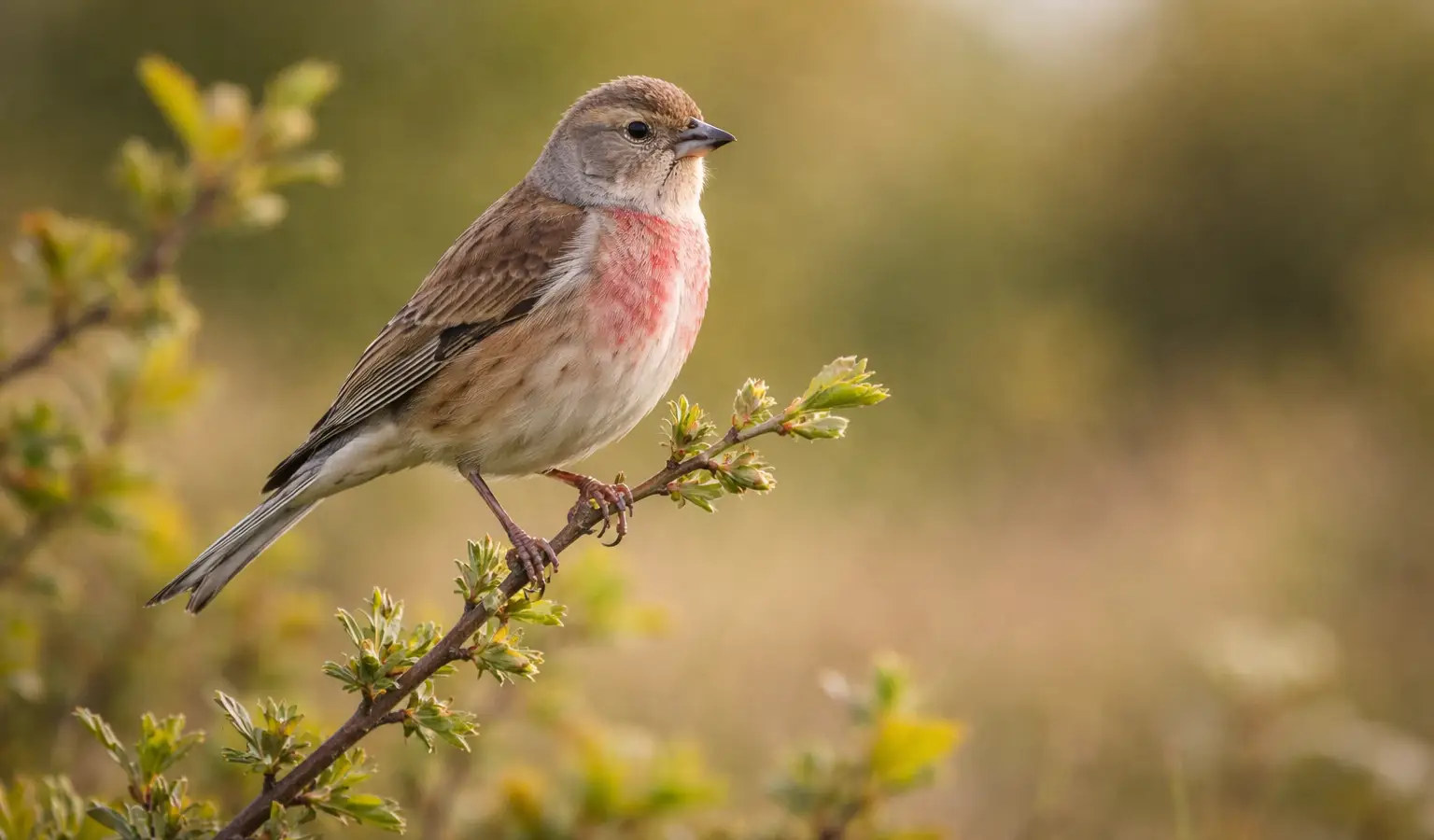
Plumage is generally brownish and streaked, but breeding males become noticeably more colorful, with a reddish forehead and pinkish to crimson tones on the breast, depending on season, wear, and individual condition. Females and non-breeding birds are duller, more buff-brown, and more heavily streaked, which can make them easy to confuse at a glance with other small finches or seed-eating passerines. The white edges in the tail and subtle pale wing markings can be useful in field observation, especially when a flock flushes from weedy ground.
At close range, the species often looks delicate rather than robust. Its call and shape are frequently as important as plumage for identification, particularly in autumn and winter when mixed flocks and worn feathers can complicate visual recognition.
Habitat and distribution
Habitat and distribution
Habitat
The Common linnet favors open habitats with scattered shrubs, rough herbaceous cover, and plentiful seed resources. It is especially associated with farmland edges, hedgerow networks, fallow land, heath, gorse patches, young conifer plantations with open margins, scrubby grassland, and some coastal habitats such as dunes or maritime scrub. It usually avoids dense closed forest interior, even if it may use woodland edge or nearby clearings.
The key biotope is a mosaic rather than a single vegetation type: nesting cover in thorny bushes, bramble, gorse, or dense shrubs, combined with nearby feeding areas rich in wild seeds. In agricultural landscapes, the species often benefits from uncultivated margins, stubble, set-aside, and patches where broadleaf weeds can flower and set seed. In more simplified or intensively managed land, local abundance may decline if nesting cover and winter food both become scarce.
For observation, the best places are usually shrubby field corners, rough tracksides, low scrub on sunny slopes, and open country where birds can move quickly between cover and feeding grounds.
Distribution
Linaria cannabina is widespread across much of Europe, parts of North Africa, and western to central Asia, with regional variation in density, migratory behavior, and winter presence. In many temperate areas it is a familiar breeding bird of lowland farmland and scrubby open country. Some populations are resident or only partly migratory, while others show clearer seasonal movement.
Occurrence is often patchy at local scale because the species depends strongly on habitat structure. It can be common in suitable traditional farmland, coastal scrub, or shrub-rich mosaics, yet scarce in heavily urbanized zones, extensive forest blocks, or very intensively cultivated areas lacking seed-rich margins. Winter distribution may shift as birds gather into flocks and use more open feeding areas than in the breeding season.
Because population trends have varied by country and period, local status should always be checked against current regional monitoring data rather than assumed from broad continental range alone.
Lifestyle
Lifestyle and behaviour
Diet
The Common linnet is primarily a seed-eating songbird. Its diet is based on small seeds from herbaceous plants, grasses, and various weeds of open ground, with buds and other soft plant material taken at times. The species has long been associated with seed-rich agricultural and semi-natural habitats, which explains its close link to field margins, rough ground, and low scrub with nearby foraging areas.
During the breeding season, adults still rely heavily on seeds, but they may also collect small invertebrates for growing chicks, as is common in many finches when nestlings require more protein. Seasonal feeding therefore often depends on a balance between nesting cover and access to diverse foraging patches. In late summer, autumn, and winter, flocks may concentrate where seed availability is highest, including stubbles, weedy fallow land, and uncultivated corners.
Where herbicide pressure, repeated mowing, or overly clean field management reduces seed-bearing plants, linnets can lose a major food base. Their feeding ecology is therefore closely tied to vegetation management and the survival of seeding plants across seasons.
Behaviour
The Common linnet is an active, alert small bird that typically feeds on the ground or on low herbaceous stems, then rises quickly to nearby shrubs or wires when disturbed. It often shows a nervous but not chaotic pattern of movement, alternating between short feeding bouts and brief lookout pauses. Its flight is light, agile, and undulating, especially when small groups move between cover and open feeding spots.
This species is often most detectable by voice. Contact calls help maintain cohesion in pairs or flocks, and birds may flush together when pressure increases. In open country, linnets tend to use scattered shrubs, hedges, or low trees as temporary refuge rather than retreating deep into dense woodland. Outside the breeding season, they can be more conspicuous because flock behavior makes movement easier to notice.
As a partial migrant, the species may show changing local behavior through the year: territorial and more discreet in spring, then increasingly social and mobile after breeding. In areas subject to regular disturbance, birds quickly learn safe feeding distances and often use a cautious pattern of repeated short flights.
Social structure
The social structure of the Common linnet changes markedly with season. During the breeding period, birds are more often seen in pairs or as loosely spaced territorial neighbors, each pair centered on a nesting area within suitable scrub or hedgerow cover. Territories are generally small and linked more to nesting security and nearby feeding access than to large defended spaces.
After breeding, family groups and local birds often merge into small flocks, and in favorable feeding areas these groups may grow larger. This flocking behavior improves vigilance and helps birds exploit patchy seed resources across farmland, rough ground, and shrubland edges. Winter flocks may also mix loosely with other small seed-eating species depending on local conditions.
Even in groups, the species remains relatively mobile and loosely organized rather than tightly synchronized like some highly gregarious birds. Cohesion is maintained through calls, shared feeding movements, and repeated use of safe perches near foraging zones.
Migration
The Common linnet is generally considered a partial migrant. Some populations are largely resident, especially in milder regions, while others move southward or toward lower, more favorable feeding areas outside the breeding season. These movements are usually less dramatic than those of long-distance migrants, but they can still produce clear seasonal changes in local abundance.
Autumn brings dispersal from breeding territories into feeding flocks, and this is often the period when birds become more visible in open country. Wintering groups may gather in seed-rich farmland, coastal scrub, or rough grassland with nearby shelter. In spring, birds redistribute back into breeding habitat, and pair formation or territory occupation becomes more evident.
Migration intensity depends on weather severity, food supply, and regional population origin. Cold spells can trigger additional local movement, while mild winters may keep birds close to breeding areas.
Reproduction
Reproduction
The breeding season usually begins in spring, with timing varying according to latitude, climate, and local food conditions. The Common linnet typically nests in dense low vegetation such as thorny bushes, gorse, bramble, hedges, or other shrubs that provide concealment. The nest is a small cup built from fine plant material and lined with softer fibers or hair.
Clutch size is commonly in the range expected for small finches, often around four to six eggs, though this can vary. Incubation lasts roughly about 14 days, and the young remain in the nest for a relatively short period before fledging. In favorable conditions, more than one brood may be attempted during a season. As with many small passerines, breeding success depends heavily on weather, predation, disturbance, and nearby food availability.
Juveniles disperse gradually after fledging and may join post-breeding groups. Given the species' short average lifespan, often only a few years in the wild, annual breeding output is important for maintaining local populations.
Field signs
Field signs
Field signs of the Common linnet are subtle compared with those of larger game species. It leaves no obvious tracks in most practical situations, and droppings are generally too small and non-distinctive to be useful except at very close range on favored perches or roost spots. The best signs are therefore behavioral and habitat-based rather than physical.
Useful clues include repeated use of the same hedge top, shrub, fence line, or wire as a lookout perch; sudden flushes of small finches from weedy ground; and light twittering contact calls revealing flock cohesion. In autumn and winter, trampled or frequently used feeding patches in seed-rich margins may indicate regular bird activity, though not necessarily linnets alone.
During breeding season, discreet movement into dense low scrub can suggest a nesting pair, but nests should not be searched for closely because disturbance can affect breeding success. For identification in the field, voice, flock shape, feeding habitat, and the forked tail in flight are usually more informative than any physical sign left on the ground.
Ecology and relationships
Ecology and relationships
Ecological role
The Common linnet plays an important role as a consumer of wild seeds in open habitats and farmland mosaics. By feeding on numerous seed-bearing plants, it contributes to the ecological dynamics of grassland edges, weed communities, and scrub-associated vegetation. It may also participate in limited seed dispersal through movement between feeding areas, though its main influence is generally as a granivorous regulator of plant resources.
During breeding, the species also links plant-based food webs with invertebrate prey taken for nestlings. In turn, linnets are prey for birds of prey and for some mammalian predators where vulnerable on or near the ground. Their nests and fledglings can be exposed to predation from small carnivores and opportunistic predators, especially in fragmented habitats.
Because linnets respond strongly to seed availability and nesting cover, they are often part of the wider ecological story of farmland biodiversity, habitat quality, and landscape management.
Human relationships
The relationship between people and the Common linnet is shaped mainly by agriculture, habitat management, birdwatching, and, in some regions, traditional hunting. For naturalists, it is a characteristic finch of open country and a useful species for reading the condition of hedgerows, rough margins, and seed-rich vegetation. Its song, flocking behavior, and seasonal color changes make it a familiar bird to observers in rural landscapes.
For farming systems, the species tends to benefit from mixed land use, uncultivated strips, and reduced pressure on seed-producing plants. It is generally not regarded as a major agricultural problem. More often, it is a species affected by the loss of weedy field edges, excessive tidying of scrub, and simplified landscapes.
In hunting contexts, relevance is local and highly dependent on law and custom. Where huntable, the species is usually associated with small-bird passage or open-country observation rather than large-scale harvest. Any discussion of hunting should remain cautious, because conservation priorities and legal frameworks can change and may differ sharply between jurisdictions.
As with many wild birds, health concerns may include avian parasites and some respiratory diseases, especially where birds congregate, though risk levels vary and should not be overstated without local evidence.
Legal framework and management
Legal framework and management
Legal status
The legal status of the Common linnet varies by country and sometimes by region, even within its broader range. In some places it may be classified as huntable during a defined season, while in others it may be protected or subject to tighter restrictions due to population concerns, migratory bird regulations, or conservation policy. The season indicated in the provided context, roughly October to January, should therefore never be treated as universally applicable.
Because the species is a migratory bird and because small passerine regulation is often sensitive, readers should consult current national and local legislation before any field action. Rules may govern season dates, permitted methods, protected areas, bag limits, and transport or possession. Conservation status and hunting status are not always the same thing, and both can change over time.
For accurate compliance, the only reliable source is the latest official regulatory text or recognized local wildlife authority.
Management tips
Management for Common linnet habitat should focus on maintaining a mosaic of nesting cover and seed-rich feeding areas. The species typically does best where hedges, bramble, gorse, scrub patches, and rough margins are available close to open ground with abundant seeding plants. Over-trimming shrubs during the breeding period or removing rough vegetation too completely can reduce both shelter and nesting opportunity.
In farmland settings, practical measures may include conserving uncultivated field edges, allowing some broadleaf plants to flower and set seed, retaining winter stubble where possible, and avoiding the complete elimination of weedy patches that support granivorous birds. Rotational rather than uniform cutting of margins and scrub can preserve structure through the year.
For observation or field assessment, focus on transition zones: hedgerow corners, rough tracksides, shrubby slopes, and post-harvest feeding areas. Early morning and late afternoon can be productive, especially when birds move between safe cover and feeding ground. Where hunting is legally practiced, pressure should remain moderate and informed by local population status, weather, passage intensity, and the wider condition of the habitat.
Fun facts
Fun facts
- The scientific name cannabina reflects the bird's historical association with seed-rich plants, including hemp-growing landscapes in earlier times.
- Male Common linnets become much more striking in the breeding season, when the reddish forehead and pink breast can make an otherwise discreet brown finch suddenly stand out.
- Although many people think of linnets as simple countryside birds, they are actually good indicators of habitat quality in farmland and scrub mosaics.
- The species is often easier to detect by its calls and flock movement than by a long, clear perched view.
- Its forked tail and bouncing flight are small but very useful identification features when a flock lifts from low vegetation.