
Common goldeneye
Bucephala clangula
A northern diving duck wintering on lakes and coastal waters.
Type
Bird
Lifespan
12 years
Hunting season
October – January
Edible
Yes
Fact sheet
Common goldeneye
Scientific name
Bucephala clangula
Type
Bird
Meat quality
Very strong-flavoured meat
Edible
Yes
Lifespan
12 years
Incubation
28 days
Size
45-55 cm
Weight
800-1000 g
Diet
Omnivore: mollusks, insects, aquatic plants
Status
Huntable under regulations
Hunting season
October – January
Breeding season
4 / 5
Lifestyle and behaviour
Behaviour : Diving duck, discreet, winters in flocks
Social structure : Groups
Migration : Winter migrant
Habitat
- Wetland
- River
- Lake
Natural predators
- Birds of prey
Hunting methods
- Hunting hide
Health risks
- Avian parasites
Ecosystem role
- Mollusk consumption
Introduction
General description
The Common goldeneye, Bucephala clangula, is a compact northern diving duck best known for its crisp black-and-white plumage in the male, bright yellow eye, and preference for cold lakes, rivers, reservoirs, and sheltered coastal waters in winter. It belongs to the group of sea ducks and diving ducks rather than dabbling ducks, and that ecological distinction matters in the field: goldeneyes feed by diving, often in relatively deep water, and usually keep a greater distance from shore than many surface-feeding waterfowl.
Across much of its range, the species is strongly associated with boreal and subarctic landscapes during the breeding season, then appears farther south as a winter migrant. In many regions it is an important bird for both wildlife observers and waterfowl hunters because it concentrates on suitable wintering waters, can gather in visible flocks, and responds clearly to weather, disturbance, and ice conditions. It is often a discreet bird at rest, but in flight it is distinctive, fast, and purposeful.
Ecologically, the Common goldeneye helps link aquatic invertebrate communities, fishless or low-fish breeding waters, wooded nesting landscapes, and wintering wetlands. Its use of tree cavities for nesting also sets it apart from many other ducks. For readers interested in game species, the goldeneye is a classic example of a huntable waterfowl that still requires careful habitat reading, lawful practice, local knowledge, and attention to migration timing and conservation rules.
Morphology
Morphology
The Common goldeneye is a medium-sized diving duck, usually around 45 to 55 cm in length and often weighing roughly 800 to 1000 g, though body mass can vary with sex, season, and condition. The species has a short neck, broad head, compact body, and relatively small bill. In profile, the head often appears steep-fronted or slightly peaked, an important field mark when comparing it with other diving ducks.
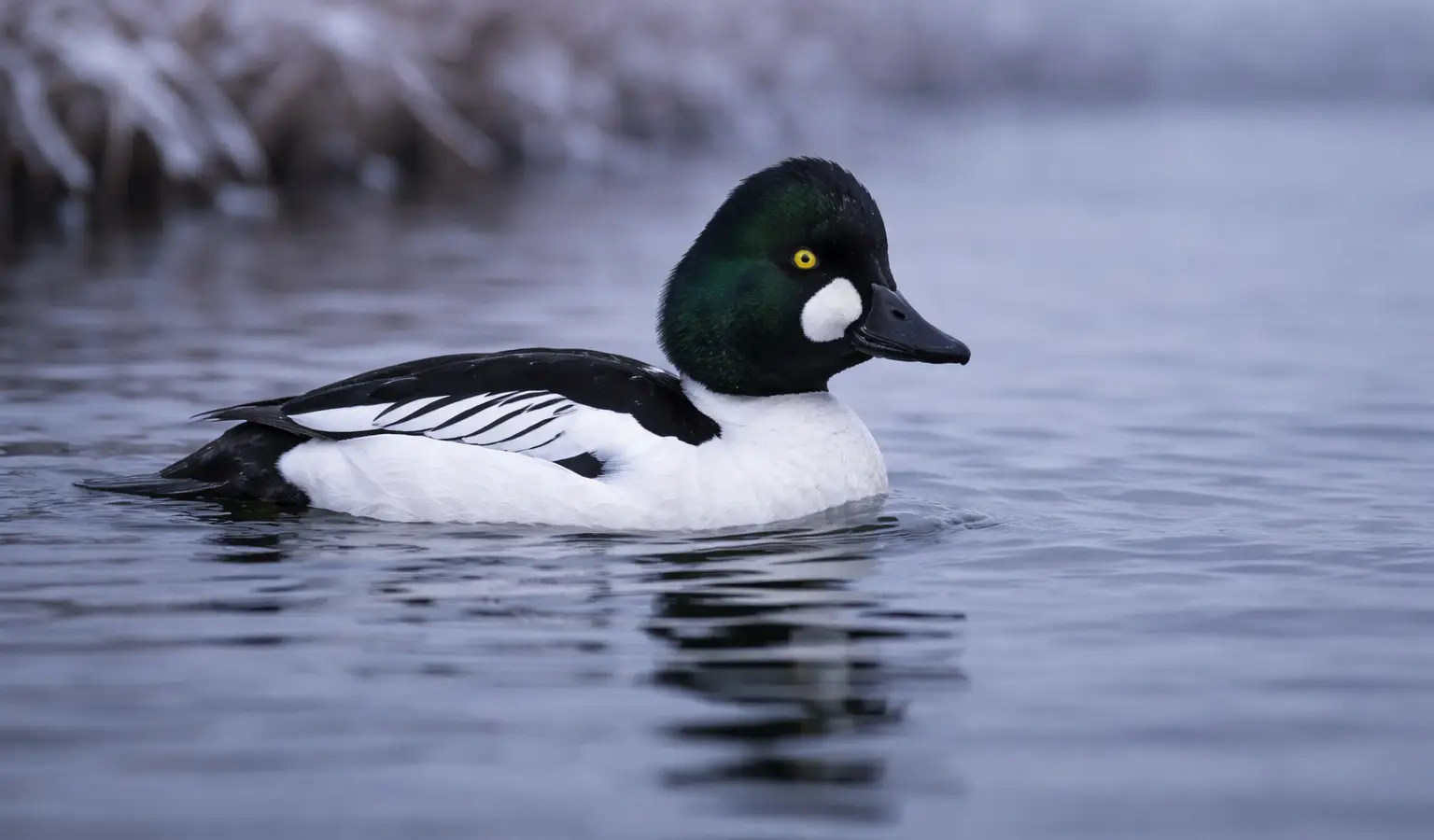
The adult male is striking: glossy dark head with greenish to black sheen depending on light, bright yellow eye, white round patch at the base of the bill, black back, and white sides and underparts. The adult female is subtler but still distinctive, with a chocolate-brown head, yellow eye, gray body, and a fairly clean boundary between the brown head and paler neck. Juveniles and eclipse plumage birds are less crisp, so structure, diving behavior, and flock context become more important for identification.
In flight, the species shows bold contrast and quick wingbeats. A useful clue is the characteristic whistling sound made by the wings, especially noticeable from males. On the water, Common goldeneyes usually ride low and dive abruptly. Their posture is neat and alert, often with the head held high when watching for danger.
Habitat and distribution
Habitat and distribution
Habitat
The preferred habitat of the Common goldeneye changes markedly between breeding and wintering seasons. During breeding, it favors northern freshwater systems such as forest lakes, ponds, slow rivers, and marshy waters bordered by mature woodland. Tree cavities are important because this duck commonly nests in holes in old trees, especially in boreal landscapes where suitable nesting sites remain available.
Outside the breeding season, the species is most often found on larger lakes, reservoirs, broad rivers, estuaries, and sheltered coastal bays. It generally selects waters that remain open in winter and offer access to aquatic invertebrates and other submerged food. Depth, water clarity, current strength, and disturbance level all influence local use. On some sites, birds stay offshore during the day and shift position with changing light, wind, boat traffic, or hunting pressure.
For practical habitat reading, look for calm water with enough depth for repeated diving, nearby loafing areas, and relatively low shoreline disturbance. Goldeneyes are less tied to shallow emergent vegetation than many dabbling ducks and are more likely to favor open water edges, channels, drop-offs, and river bends where prey is accessible below the surface.
Distribution
Bucephala clangula has a broad northern distribution across Eurasia and North America, with major breeding populations centered in boreal and subarctic zones. In the Western Palearctic, it breeds widely across Scandinavia, parts of northern and eastern Europe, and across Russia through forested northern regions. Local breeding also occurs farther south where suitable woodland lakes and nest sites persist, but densities are usually much lower and patchier.
In winter, Common goldeneyes move southward into temperate regions. They can be found on inland lakes and rivers and along marine coasts, especially where water remains unfrozen. Their winter occurrence often fluctuates with cold spells, ice cover, and regional weather patterns. Severe winters can push birds farther south or concentrate them in limited open-water areas, while mild winters may leave more birds farther north.
At local scale, distribution is often uneven. Some wetlands hold regular wintering groups every year, while apparently similar waters remain little used. Food availability, roosting safety, disturbance pressure, and traditional site fidelity all likely contribute to these patterns.
Lifestyle
Lifestyle and behaviour
Diet
The Common goldeneye is an opportunistic omnivore with a diet dominated in many places by aquatic animal prey. Mollusks, aquatic insects and their larvae, crustaceans, and other invertebrates are important foods, especially in winter and on staging waters. Small fish, fish eggs, or amphibian material may also be taken at times, depending on local availability, although in many inland situations invertebrates remain the core resource.
Plant material is eaten as well, including seeds and submerged aquatic vegetation, but the species is generally more animal-oriented than many dabbling ducks. Because it feeds by diving, prey choice is closely tied to bottom type, depth, water temperature, and seasonal prey cycles. Sandy or stony substrates, mussel beds, and productive invertebrate zones can attract repeated use.
Season matters. During breeding and brood-rearing, females and ducklings depend heavily on nutrient-rich aquatic invertebrates. In winter, flocks often exploit concentrated prey in deeper water, and feeding intensity may increase during cold periods when energetic demand rises. On heavily disturbed sites, birds may shift much of their feeding to quieter hours.
Behaviour
The Common goldeneye is a vigilant, often discreet diving duck with a calm appearance on the water but very rapid reactions when alarmed. It spends much of its active time diving, surfacing briefly, then submerging again in a steady feeding rhythm. Compared with many surface-feeding ducks, it tends to use more open water and may hold itself farther from banks, reed edges, or visible shoreline cover.
Daily behavior can vary with weather, disturbance, and season. Wintering birds often alternate between feeding bouts and resting periods on open water. In places with frequent boat traffic, shooting pressure, or pedestrian disturbance, they may become noticeably more wary, raft farther offshore, or move among nearby waters during the day. Strong winds and freezing conditions can also reshape local patterns very quickly.
When flushed, Common goldeneyes take off directly from the water with fast wingbeats and can depart low over the surface before gaining height. Their flight is strong, compact, and purposeful. They are not usually the noisiest duck in voice, but the whistling sound of the wings is a classic field clue and often betrays passing birds before plumage details are fully visible.
Social structure
Outside the breeding season, Common goldeneyes are typically found in groups, from small parties to loose flocks on suitable wintering water. These flocks may be mixed by sex and age, although local segregation can occur, with some sites holding more males than females or vice versa depending on habitat and seasonal timing. Birds often maintain individual spacing while resting or feeding, especially on open water.
During breeding, the social structure becomes more dispersed. Pairs are territorial or at least strongly spaced around nesting and brood-rearing areas, particularly where nest cavities and productive water are limited. Females rear broods on water, while males typically play little role in parental care after the female begins incubation. Brood groups may sometimes appear near one another on favorable wetlands, but the breeding system is far less flock-oriented than winter behavior.
In migration and winter, site fidelity can be important. Some birds return to the same general wintering waters year after year if habitat quality remains stable and disturbance is manageable.
Migration
The Common goldeneye is best described in many temperate areas as a winter migrant. Breeding birds from northern forest regions move south or southwest after the breeding season, seeking ice-free waters with reliable feeding opportunities. Autumn arrival varies by latitude and weather, but noticeable increases often occur from late autumn onward, especially as northern waters begin to freeze.
Migration is strongly weather-dependent. Cold snaps can produce sudden movements and temporary concentrations on rivers, reservoirs, estuaries, or coastal inlets. Conversely, mild winters may reduce southward displacement and leave more birds closer to breeding regions. Spring departure generally tracks thawing conditions and the reopening of northern freshwater habitats.
At a regional level, movement is not always a simple long-distance migration. Some birds make shorter shifts between inland and coastal waters, or between exposed and sheltered sites, according to ice cover, feeding conditions, and disturbance. For observers and hunters alike, understanding these short-term adjustments is often more useful than relying only on calendar dates.
Reproduction
Reproduction
The breeding biology of the Common goldeneye is notable because it is one of the cavity-nesting ducks. Nesting usually occurs in tree holes, old woodpecker cavities, natural hollows, or occasionally nest boxes near freshwater. This dependence on mature trees makes woodland structure an important part of the species' breeding ecology. Egg laying generally takes place in spring, varying with latitude and ice breakup.
The female lays a clutch that is often moderate to fairly large for a duck, though exact clutch size varies. Incubation is handled by the female alone and typically lasts around 28 days. After hatching, the ducklings leave the nest very early, sometimes making remarkable jumps from elevated cavities to the ground below. The female then leads them to water, where the brood feeds primarily on aquatic invertebrates.
Young birds grow quickly in productive wetlands, but brood success depends on predation risk, weather, food supply, and water conditions. Birds of prey, mammalian predators, and nest competition can all affect local breeding output. Under favorable conditions, Common goldeneyes may live for more than a decade, with a lifespan around 12 years being a reasonable broad reference rather than a fixed rule.
Field signs
Field signs
Field signs of the Common goldeneye are usually more visual and behavioral than terrestrial. Unlike many land birds or mammals, it often leaves few obvious signs on shore. The best clues are repeated use of open-water sectors, diving activity in the same feeding lane, floating resting groups on sheltered stretches, and characteristic takeoff behavior when disturbed.
For field observation, watch for small to medium diving ducks sitting relatively low on the water, disappearing in quick dives, then resurfacing a short distance away. In flight, the strong contrast of the male and the whistling wings are especially useful. Females are subtler, so head shape, yellow eye, compact silhouette, and diving habit become more important.
Physical traces may occasionally include feathers near roosting or loafing edges, droppings on favored resting structures, or use of nest boxes and tree cavities in breeding regions. Tracks are rarely the most reliable sign in wetland mud because birds often come ashore only briefly. For practical detection, repeated scanning of open water with optics is far more effective than searching shoreline prints.
Ecology and relationships
Ecology and relationships
Ecological role
The Common goldeneye plays a practical ecological role as a predator of aquatic invertebrates, especially mollusks and insect larvae, and therefore contributes to the structure of freshwater and coastal food webs. By foraging repeatedly on submerged prey, it participates in energy transfer from benthic and near-bottom communities to higher trophic levels.
Its breeding strategy also links aquatic and woodland habitats. Because it depends on tree cavities or similar nest sites, the species reflects the ecological value of mature forests around lakes and wetlands. In that sense, goldeneyes can be viewed as indicators of habitat continuity where productive water and old trees occur together.
As prey, eggs, ducklings, and occasionally adults may support raptors and other predators. The species therefore occupies both consumer and prey roles within wetland ecosystems. In managed landscapes, healthy goldeneye populations can signal functional wintering waters with suitable food, open-water refuge, and moderate disturbance levels.
Human relationships
The relationship between people and the Common goldeneye is shaped by observation, wetland management, and regulated hunting. Birdwatchers value it as a distinctive winter duck that is often easier to find on open lakes and coasts than in dense marsh vegetation. Its bold plumage, wing whistle, and diving behavior make it a rewarding species for identification and seasonal monitoring.
In hunting culture, where legal and sustainable harvest is allowed, the species is regarded as a legitimate waterfowl quarry, though often not the easiest duck to approach. Its tendency to hold on open water, react quickly to disturbance, and shift with weather means success depends on careful site reading, concealment, legal shooting opportunities, and sound species identification. The indicated season in some areas may run roughly from October to January, but local dates vary and should never be assumed without checking current regulations.
As table fare, the species is considered edible, though culinary opinion varies with diet, condition, and preparation. More broadly, the Common goldeneye benefits from human actions that preserve mature lakeside trees, maintain clean aquatic systems, and limit excessive disturbance on key wintering waters. Conversely, loss of nesting cavities, shoreline development, pollution, and repeated pressure can reduce habitat quality.
Legal framework and management
Legal framework and management
Legal status
The Common goldeneye is huntable under regulations in some jurisdictions, but legal status is always country- and region-specific. Open seasons, bag limits, permitted methods, protected areas, non-toxic shot rules, and species identification requirements can all differ substantially. Because migratory waterfowl law changes regularly, hunters and land managers should consult the current official framework in their exact area before any activity.
Even where harvest is legal, the species may be subject to broader migratory bird agreements, wetland protection measures, and site-based restrictions on important wintering or breeding waters. In some places, local populations may be stable; in others, distribution or abundance may vary enough to justify a cautious management approach.
From a practical perspective, lawful take depends not only on season dates but also on correct identification, respect for closed areas, and awareness of other similar diving ducks that may have different conservation or hunting status.
Management tips
Good management for Common goldeneye begins with habitat reading. Productive winter waters usually combine open surface area, manageable disturbance, and a reliable submerged food base. Reservoir arms, broad river reaches, lake basins, estuarine margins, and sheltered coastal sectors can all be valuable if they remain accessible in cold weather. Regular counts help distinguish occasional stopovers from true seasonal holding areas.
On breeding landscapes, retaining mature trees and cavity-bearing woodland near freshwater is especially important. Where natural cavities are scarce, well-designed nest box programs may help locally, provided placement, predator protection, and long-term maintenance are handled properly. Water quality also matters: aquatic invertebrate-rich systems support both adult condition and brood development.
For hunters, observation before action is essential. Because Common goldeneyes are wary and often use open water, pressure can quickly move birds off a site or alter daily patterns. Low-disturbance approaches, accurate identification, legal hide use where permitted, and restraint on repeatedly shooting the same resting water are sensible practices. For managers and observers alike, severe weather, ice cover, and boating pressure should be tracked because they can change distribution within days.
- Prioritize open water with low repeated disturbance.
- Protect mature lakeside trees and cavity resources.
- Monitor winter concentrations during freezing periods.
- Avoid overinterpreting one-day presence as stable habitat use.
- Check current regulations before any hunting activity.
Fun facts
Fun facts
The scientific name Bucephala clangula reflects the species' striking head shape and ringing, noticeable presence, and the bird is famous among waterfowl observers for the male's bright golden-yellow eye, which explains the common name goldeneye.
One of the most memorable features of the Common goldeneye is that newly hatched ducklings may leap from a tree cavity nest long before they can fly, surviving the drop because they are extremely light and covered in down. It is one of the more remarkable sights in duck breeding biology.
The species is also well known for the sharp whistling sound of its wings in flight, a clue that often identifies passing birds before binoculars confirm plumage details. For many field observers, hearing that wing sound over a cold lake is one of the classic signatures of winter waterfowl season.