
Chamois
Rupicapra rupicapra
A highly agile mountain ungulate found across several European ranges.
Type
Large mammal
Lifespan
13 years
Hunting season
Octobre à décembre selon quotas
Edible
Yes
Fact sheet
Chamois
Scientific name
Rupicapra rupicapra
Type
Large mammal
Meat quality
Tender meat
Edible
Yes
Lifespan
13 years
Gestation
170 days
Size
120-140 cm
Weight
25-45 kg
Diet
Herbivore: grasses, leaves, buds, lichens
Status
Huntable depending on local regulations
Hunting season
Octobre à décembre selon quotas
Breeding season
10 / 11
Lifestyle and behaviour
Behaviour : Diurnal, very alert, excellent climber, lives in groups
Social structure : Small groups; males often more solitary
Migration : Altitudinal migrations between summer and winter
Habitat
- Mountain
Natural predators
- Wolf
Hunting methods
- Blinds
- Stalking
Health risks
- Intestinal parasites
- Ovine plague
Ecosystem role
- Seed dispersal
Signs of presence
- Tracks on rocks
- Droppings
Introduction
General description
The chamois, Rupicapra rupicapra, is one of Europe’s most characteristic mountain ungulates. Built for steep ground, it combines the sure-footedness of a cliff animal with the wariness of a true big game species. It is widely associated with alpine and subalpine landscapes, where it uses rocky slopes, open grassland, broken forest edges, avalanche corridors, and high ridges. For many observers, the chamois is a symbol of wild mountain country because it remains active in exposed terrain where weather, snow, slope, and visibility shape daily survival.
Although often described simply as a mountain goat-antelope, the chamois has its own distinct ecology and behavior. It is a medium-sized herbivore that feeds on grasses, herbs, buds, leaves, and other mountain vegetation, adjusting its use of habitat with season, snow cover, disturbance, and forage quality. Its role in mountain ecosystems includes plant consumption, seed movement, and serving as prey where large carnivores such as wolves are present.
In wildlife watching and hunting contexts, chamois are valued for their alertness, keen senses, and ability to detect danger early. They can be difficult to approach in open country, especially where hunting pressure, tourism, or predator presence has made them cautious. This combination of visibility and elusiveness is part of what makes the species so important in mountain game management.
Across its range, the status of the chamois depends heavily on local conditions. Some populations are stable and huntable under quota systems, while others may be more sensitive to harsh winters, disease, disturbance, habitat fragmentation, or predation pressure. For that reason, any serious understanding of chamois should connect identification and natural history with landscape-scale management and regional regulation.
Morphology
Morphology
The chamois is a compact, athletic large mammal typically measuring about 120 to 140 cm in body length and commonly weighing around 25 to 45 kg, though body mass varies with sex, age, season, and local population. It has a relatively short body, strong neck, deep chest, and powerful legs adapted for climbing, jumping, and moving across broken rock, scree, and steep snow. The silhouette is neat and agile rather than heavy.
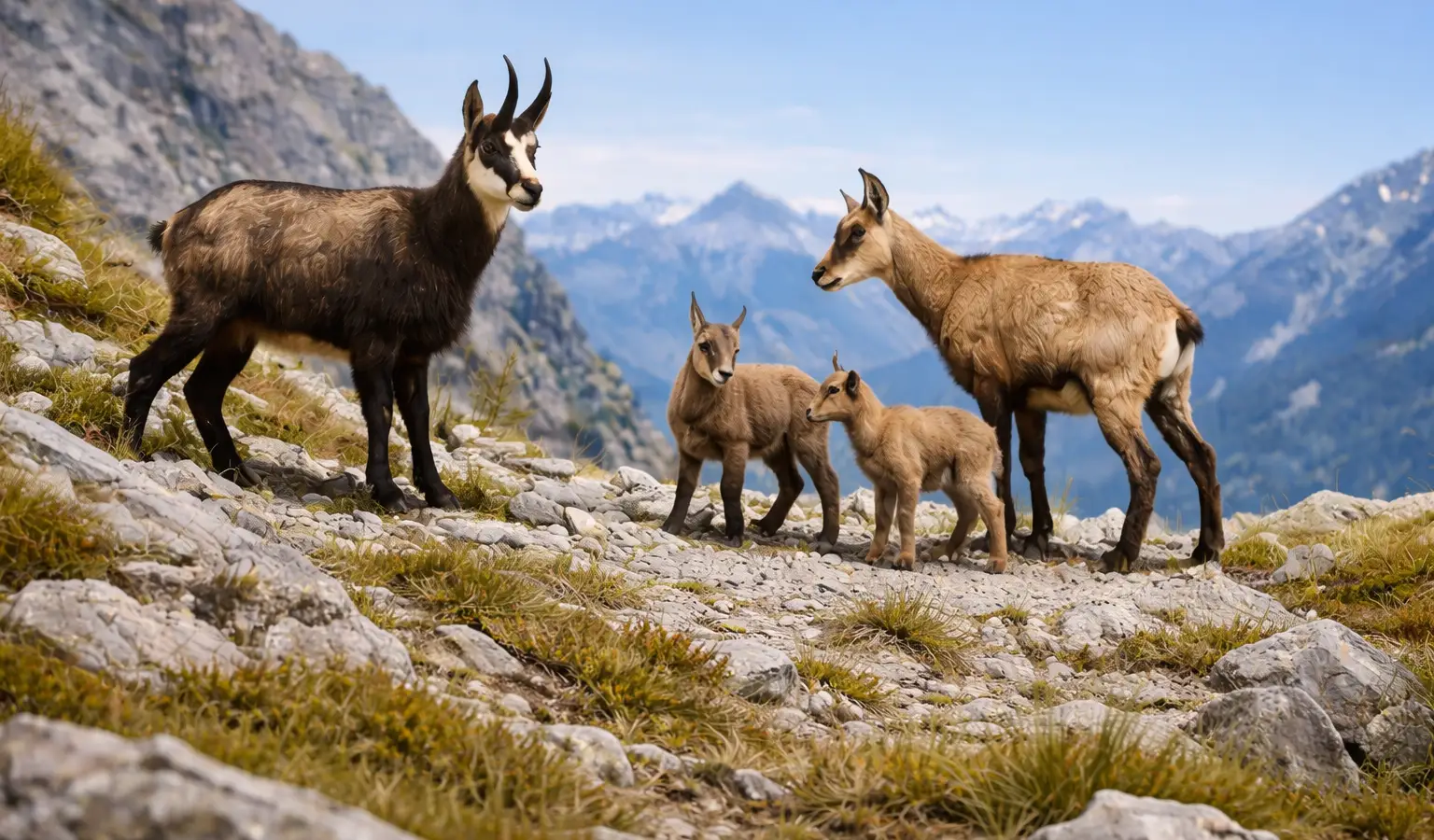
One of the clearest field marks is the pair of slender, black horns present in both sexes. These horns rise fairly straight and then hook backward near the tip. Males usually carry thicker, more robust horns, but sexing animals at distance is not always simple without good optics and experience. The head often shows a pale face with darker stripes running from the muzzle toward the eyes, giving the species a distinctive expression.
Coat color changes seasonally. In warmer months, chamois tend to appear lighter brown to reddish-brown, while in winter the coat becomes darker, thicker, and more insulating, often with stronger contrast between dark body areas and paler facial or throat markings. The rump patch and body tones can be useful for identification, but light, distance, angle, and molt stage may alter appearance. In motion, the species is recognized by fluid climbing ability and balanced movement over terrain that appears nearly inaccessible.
Habitat and distribution
Habitat and distribution
Habitat
Chamois prefer mountain habitat with a combination of escape terrain and forage. Typical biotopes include alpine meadows, subalpine slopes, rocky outcrops, ledges, scree, open conifer margins, shrub zones, and mosaic landscapes where grazing areas lie close to cliffs or broken relief. This mix lets them feed efficiently while retaining immediate access to steep refuge ground.
They are especially associated with environments where topography creates visual advantage and rapid escape options. South-facing slopes may be important in winter where snow is shallower, while cooler slopes, high grasslands, and herb-rich areas can be favored in summer. Their habitat use is not fixed: it shifts with snow depth, temperature, plant growth, insect pressure, human disturbance, and predation risk.
In some regions, chamois also use forested cover more than casual observers expect, particularly near dawn, dusk, or in adverse weather. Dense woodland is usually less characteristic than open mountain structure, but forest edges, regeneration patches, and sheltered gullies can be important resting or transitional areas. Habitat quality depends not only on vegetation but also on continuity of movement routes between seasonal elevation bands.
Distribution
Rupicapra rupicapra occurs across several European mountain systems, with well-known populations in the Alps and additional presence in parts of the Carpathians, Balkans, and other suitable upland ranges depending on taxonomy and regional classification. Distribution is therefore strongly tied to mountain geography rather than to broad lowland continuity.
Within occupied ranges, chamois are often patchily distributed according to slope, snow conditions, forest structure, human access, and management history. Some areas support dense and visible populations, while others hold scattered groups that are harder to observe because they use rough terrain, forest-edge shelter, or remote high country. Local abundance can fluctuate through time due to winter severity, disease events, predation, and harvest policy.
Introductions and translocations have occurred in some parts of Europe, so modern occurrence does not always reflect only original natural distribution. For practical field purposes, the species is most likely to be found wherever large connected mountain landscapes still provide a combination of forage, shelter, and safe escape terrain.
Lifestyle
Lifestyle and behaviour
Diet
The chamois is a herbivore whose diet includes grasses, sedges, forbs, leaves, buds, shoots, lichens, and other available mountain vegetation. What it eats depends strongly on season, altitude, plant phenology, snow cover, and grazing competition. In productive months, it often selects fresh, nutritious green growth, especially herbs and young grasses in alpine and subalpine pasture.
As conditions harden, the diet can shift toward tougher or more scattered resources such as woody browse, evergreen material, buds, and lichens. In winter, forage accessibility may matter more than forage quality, especially in deep snow or on wind-exposed slopes where plant material remains reachable. Animals may move to elevations or aspects where feeding costs are lower.
Feeding strategy is closely linked to energy balance. Mountain ungulates must manage limited nutrition, changing weather, and the physical cost of travel across steep ground. This makes habitat structure just as important as botanical composition. Areas offering both quality forage and secure terrain often hold repeated use. In heavily used mountain systems, diet may also be shaped by livestock overlap, tourism disturbance, and local carrying capacity.
Behaviour
Chamois are mainly diurnal, with activity concentrated around the cooler and quieter parts of the day, although exact patterns may shift with season, weather, and disturbance. They spend much of their time feeding, scanning, resting, and moving between feeding patches and secure terrain. During hot weather or in areas with frequent human presence, they may become more crepuscular in practice, using early morning and late afternoon more heavily.
They are notably alert animals with excellent vision and a strong tendency to monitor their surroundings from vantage ground. A group will often contain one or more individuals that spend extended periods watching while others feed. When alarmed, chamois typically move uphill or across steep side slopes with remarkable speed and balance. Escape behavior may involve short bursts to rocky refuge rather than long-distance flight, though repeated disturbance can push animals into less visible areas.
Weather influences daily behavior. Wind, fog, fresh snow, and heat can all affect where animals feed and rest. In exposed mountain terrain, a small change in microclimate may alter movement patterns noticeably. Hunting pressure and predator presence can also make chamois more cautious, more difficult to approach, and more inclined to use broken terrain or cover transitions.
Social structure
Social organization in chamois is flexible but generally follows a recognizable pattern. Females, kids, and young animals are often found in small groups, while mature males are more frequently solitary or loosely associated outside the breeding season. Group size varies with habitat openness, season, population density, weather, and disturbance level.
These groups are not always rigid, permanent units. Mountain ungulate group composition can shift through time as animals separate, merge, or spread out across feeding slopes. In open summer terrain, several individuals may feed within sight of one another without forming a tightly cohesive herd. In winter, local concentration can increase where snow-free or windblown feeding areas are limited.
Adult males may become more visible around females during the rut, but for much of the year they often use habitat somewhat differently, sometimes occupying quieter, rougher, or more secluded sectors. Understanding this social pattern is useful not only for observation but also for age and sex-based management in hunted populations.
Migration
Chamois are not long-distance migrants in the classic sense, but they commonly perform altitudinal migrations or seasonal shifts between summer and winter ranges. In warmer months, many animals use higher feeding grounds where alpine vegetation is productive. As snow deepens and conditions deteriorate, they often move lower or toward slopes with less snow accumulation, better exposure, and easier access to forage.
These movements are shaped by topography, aspect, weather, and disturbance. In some mountain systems, the shift may be quite regular and predictable. In others, especially where forest cover, local feeding opportunities, or microclimate vary greatly, movement can be more localized and less obvious. Not every population shows the same degree of seasonal displacement.
Young animals may also disperse from natal areas, contributing to local range expansion or recolonization where habitat connectivity remains intact. Roads, ski infrastructure, repeated disturbance, and fragmented mountain corridors can all interfere with traditional movement patterns and increase stress during difficult seasons.
Reproduction
Reproduction
The breeding cycle of the chamois typically includes an autumn rut, often peaking in late fall, though exact timing can vary by region and elevation. During this period, males increase their movements, pay close attention to female groups, and may display more territorial or competitive behavior. Vocalizations, posturing, chasing, and close following of females can be observed where terrain allows good visibility.
Gestation lasts about 170 days. Most births occur in spring, when improving weather and new vegetation provide better conditions for lactation and early growth. A female usually gives birth to a single kid; twins are possible but are less typical. The newborn is precocial and able to stand and move quickly, an important trait in steep country where vulnerability to exposure, falls, and predation must be reduced immediately.
Maternal care is important during the first weeks and months. Females tend to use secure nursery areas that combine visibility, forage access, and escape terrain. Kid survival depends on weather, maternal condition, disturbance, predation pressure, and habitat quality. Sexual maturity and full body development take time, and older adults often dominate the most favorable behavioral positions within a group.
Field signs
Field signs
Finding chamois often depends more on reading terrain than on looking for obvious sign in the lowland sense, but several field clues are useful. Tracks may appear on soft ground, snow, mud, or fine scree near crossing points, feeding shelves, and approach lines to ridges. On bare rock, prints are naturally harder to detect, yet repeated use often reveals routes across ledges, gullies, saddles, and access ramps.
Droppings are a common sign and are often found on feeding areas, resting spots, trail junctions, and sheltered edges beneath rock or scrub. They usually occur as small dark pellets, though shape and moisture vary with diet and season. Concentrated pellet groups may indicate repeated bedding or pause areas rather than just casual passage.
Other signs can include narrow trails contouring steep slopes, clipped vegetation in favored feeding patches, polished passage zones through dwarf shrubs, and resting places on dry sheltered shelves with good visibility. In snow, fresh movement patterns can be especially informative, showing how animals avoid deep drifts and favor wind-scoured ground. In practice, the best field sign is often the combination of droppings, tracks, and terrain logic rather than any single mark taken alone.
Ecology and relationships
Ecology and relationships
Ecological role
As a native mountain herbivore, the chamois plays a meaningful role in alpine and subalpine ecosystems. Through grazing and browsing, it influences plant communities, especially in areas where herbivore pressure is concentrated by slope, snow patterns, or limited feeding ground. Its feeding can affect vegetation structure, regeneration, and the balance between grasses, herbs, and woody plants.
Chamois also contribute to seed dispersal, both externally through contact with vegetation and internally through movement after feeding. In mountain environments where plant colonization depends on disturbance, slope processes, and patchy soils, animal movement can help distribute propagules across elevation gradients and habitat edges.
Where large predators such as wolves occur, chamois form part of the prey base and are therefore connected to wider trophic dynamics. Carcasses from natural mortality can also support scavengers. Their ecological importance is best understood not in isolation but as part of a mountain network shaped by climate, vegetation, predation, disease, and human land use.
Human relationships
The relationship between people and chamois is long-standing and complex. In many European mountain regions, the species is culturally important for wildlife observation, local identity, and traditional mountain hunting. It is admired for its agility, caution, and ability to occupy severe terrain that remains largely inaccessible to domestic life. For photographers and naturalists, seeing chamois often defines the experience of high country wildlife.
In hunting contexts, chamois is regarded as a demanding big game species because success depends heavily on mountain reading, optics, patience, physical condition, and careful shot selection in difficult terrain. Stalking is a classic method, and blinds may also be used depending on local practice and landscape. Because the meat is edible and valued in many areas, harvest has both cultural and practical significance where legally regulated.
At the same time, coexistence can involve challenges. Chamois may overlap with livestock on summer range, and disease transmission concerns can arise where domestic and wild ungulates share space. Tourism, winter sports infrastructure, and repeated recreational disturbance can alter movement and resting behavior. Good coexistence generally depends on calm seasonal zoning, habitat continuity, disease monitoring, and responsible management.
Legal framework and management
Legal framework and management
Legal status
The legal status of the chamois varies by country, region, and management unit. In many areas it is a huntable game species, but hunting is typically controlled through seasons, quotas, permit systems, and sometimes sex or age-class rules. The information provided here indicates a common hunting period of roughly October to December depending on local quotas, but exact dates and conditions must always be checked in current local regulations.
Even where huntable, chamois management is usually tied to population monitoring, mountain habitat conditions, winter mortality, and disease risk. Some sectors may have stricter protection, temporary closures, or special rules near reserves, national parks, border zones, or sensitive reproductive areas. Regional conservation status can differ substantially from one massif to another.
Because mountain wildlife law changes over time and often reflects both biological data and social priorities, no hunter or observer should rely on generalized summaries alone. The only reliable legal reference is the competent authority in the relevant jurisdiction.
Management tips
Effective chamois management begins with understanding seasonal mountain use rather than treating the species as uniformly distributed. Counts and observations are most meaningful when linked to elevation, slope exposure, snow conditions, vegetation stage, and disturbance levels. A population that appears absent from one sector may simply have shifted temporarily due to weather, tourism, or predator pressure.
- Prioritize protection of movement corridors between summer and winter habitat.
- Monitor age and sex structure, not just total numbers, especially in hunted populations.
- Watch for disease risks where wild chamois overlap with domestic sheep or goats.
- Reduce repeated disturbance in winter refuges and nursery areas.
- Interpret body condition, kid recruitment, and winter survival together before adjusting harvest pressure.
For field observation, use optics from distance and avoid pushing animals repeatedly across steep ground, especially in winter when energy costs are high. For habitat reading, focus on the interface between forage and escape terrain: grassy ledges near rock, forest-edge openings below cliffs, windblown ridges, and calm morning feeding slopes are often productive places to understand chamois use. In hunting or monitoring alike, patience and terrain knowledge usually matter more than constant movement.
Fun facts
Fun facts
The chamois is famous for moving across terrain that looks almost impossible to humans, yet much of this ability comes from balance, hoof structure, and experience rather than reckless speed. What seems effortless is actually highly efficient mountain locomotion.
Both male and female chamois carry horns, which is a useful distinction from several deer species and a frequent point of interest for first-time observers.
Its seasonal coat change can make the same animal look surprisingly different between summer and winter, especially at distance.
Although often grouped mentally with ibex in popular culture, the chamois occupies its own ecological niche and often uses a broader mix of grassland, rocky terrain, and forest edge.
In many mountain regions, seeing a line of chamois feeding quietly along a steep dawn slope is one of the most memorable wildlife observations the European highlands can offer.