
Blackbird
Turdus merula
A common songbird, hunted locally during migration.
Type
Bird
Lifespan
4 years
Hunting season
October – January
Edible
Yes
Fact sheet
Blackbird
Scientific name
Turdus merula
Type
Bird
Meat quality
Red and tasty meat
Edible
Yes
Lifespan
4 years
Incubation
14 days
Size
24-27 cm
Weight
80-120 g
Diet
Insects, fruits, berries
Status
Huntable locally
Hunting season
October – January
Breeding season
4 / 5 / 6
Lifestyle and behaviour
Behaviour : Partial migrant, pairs or small groups
Social structure : Territorial pairs
Migration : Partial migrant
Habitat
- Forest
- Urban fringe
Natural predators
- Birds of prey
- Wild cat
Hunting methods
- Standing post
Health risks
- Avian parasites
- West Nile virus
Ecosystem role
- Insect regulation
Introduction
General description
The Common Blackbird, Turdus merula, is one of the most familiar thrushes in Europe and many nearby regions. Although often associated with gardens, hedgerows, woodland edges, and village outskirts, it is equally a genuine wild bird of forest margins, scrub, orchards, and mixed farmland. It is best known for its rich, flute-like song, but in field ecology it is also notable as a highly adaptable species able to exploit both natural and human-shaped environments.
In wildlife terms, the blackbird occupies an important middle ground between songbird, small game bird in some local traditions, and ecological indicator of healthy edge habitat. It feeds heavily on insects, worms, fruits, and berries, linking soil life, shrub layers, and seed dispersal processes. During autumn and winter, especially in regions influenced by migration, local abundance can rise as passing birds join resident populations.
From a hunting perspective, the species has historically been taken in certain areas during migration or winter movements, often from fixed positions where passage is observed. That relevance is very regional and heavily regulated. In many places the blackbird is more commonly watched than hunted, yet its status in hunting culture remains part of the search intent around the species, especially where traditional migratory bird hunting persists.
For readers trying to identify, understand, or manage habitat for blackbird presence, the key themes are adaptation, territory, seasonal movement, and the value of dense cover near feeding ground. Few birds illustrate the ecological importance of the woodland edge and urban fringe as clearly as Turdus merula.
Morphology
Morphology
The blackbird is a medium-sized thrush, typically around 24 to 27 cm in length and often weighing roughly 80 to 120 g, though body mass can vary with season, condition, and migration. Its structure is classic thrush-like: rounded body, fairly long tail, strong legs, and a straight to slightly slender bill suited to probing soil and taking soft fruits.
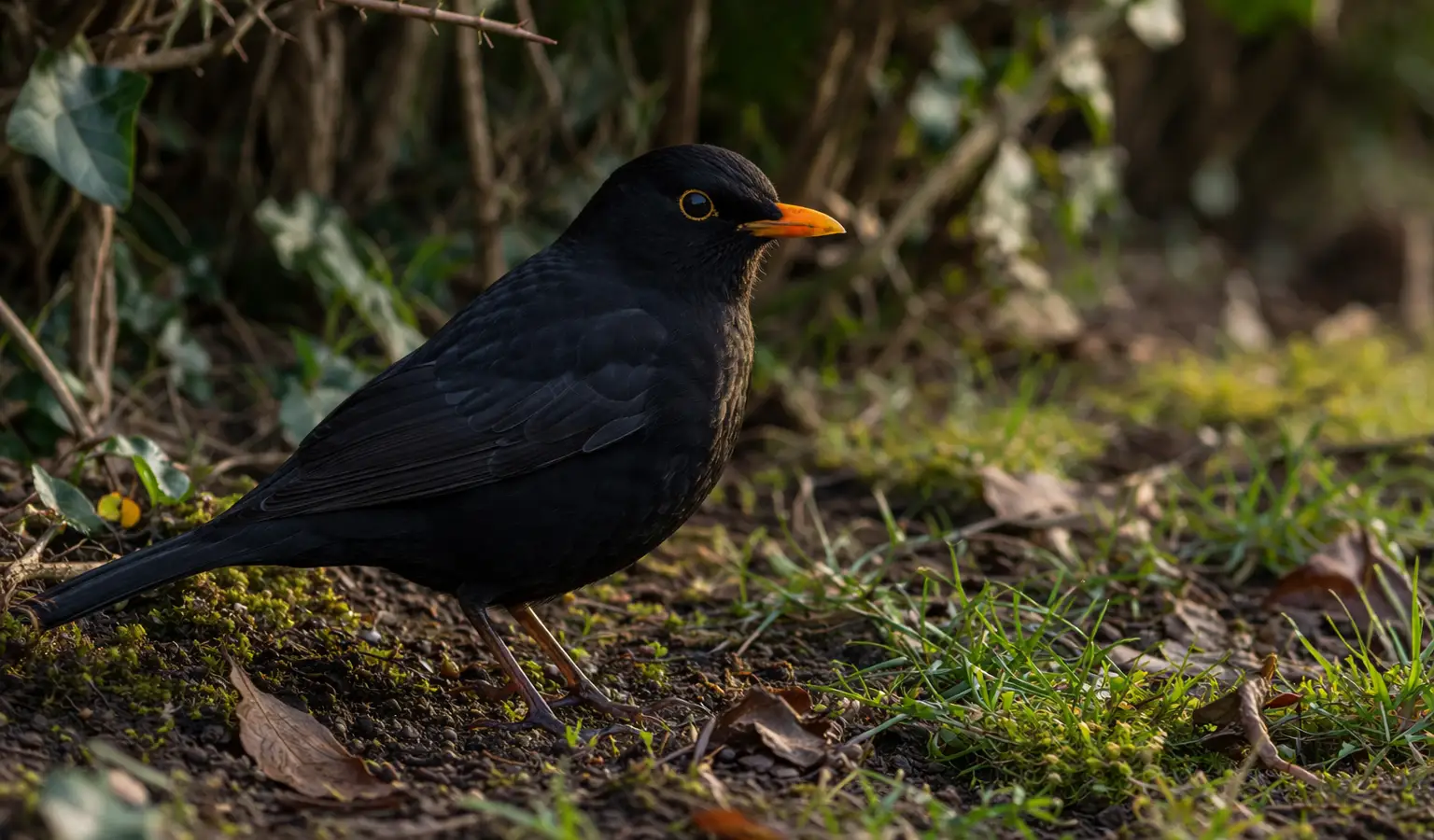
Adult male Common Blackbirds are usually easy to identify. They are mostly black overall, with a bright yellow to orange-yellow bill and a conspicuous yellow eye-ring. Adult females are more subdued, generally dark brown to warm brown, often with paler or mottled underparts and a darker bill. Juveniles are browner and more spotted or scaled-looking, especially on the breast, which can cause confusion with other thrushes at a distance.
In the field, the species often shows a characteristic posture: alert, upright pauses alternating with short runs or hops on the ground. In flight it appears direct and low, frequently diving into cover. The tail can look relatively long, and the wingbeats are quick and purposeful. The male's dark plumage and bright bill are especially useful for identification in open light, while females are better identified by shape, behavior, and habitat context than by plumage alone.
Habitat and distribution
Habitat and distribution
Habitat
Turdus merula thrives in a broad range of habitats, provided there is a combination of cover, feeding ground, and nesting structure. The classic blackbird biotope includes woodland edge, coppice margins, dense hedgerows, thickets, orchards, scrubby clearings, and mixed agricultural land with bushes or tree lines. It is also strongly associated with the urban fringe, parks, cemeteries, gardens, and suburban green spaces.
The species generally favors habitats with moist or workable soil for invertebrate feeding, especially during the breeding season, and berry-bearing shrubs or fruit resources in autumn and winter. Dense vegetation is important for concealment, roosting, and nest placement. Blackbirds often avoid the most exposed open country unless cover is close by, and they make especially good use of ecotones where woodland, field, and shrub layers meet.
In practical terms, good blackbird habitat usually includes several layers: ground feeding areas, low cover for escape, and shrubs or small trees for song posts and nesting. Where winter migrants occur, sheltered valleys, coastal belts, orchards, olive groves in some regions, and mosaic landscapes with fruiting vegetation can hold higher seasonal numbers.
Distribution
The Common Blackbird has a very broad distribution across much of Europe, North Africa, and parts of western and central Asia, and it has also been introduced in some regions beyond its native range. Within its core range it is one of the most widespread and recognizable thrush species.
Occurrence patterns vary with latitude, altitude, and climate. In milder areas many populations are largely resident, while in colder northern or continental regions the species is more migratory or partially migratory. This means that some areas support blackbirds year-round, whereas others see notable autumn and winter influxes. Mountain populations may also shift downslope in harsh weather.
At local scale, distribution is rarely random. Blackbirds are most consistently present where nesting cover, feeding substrate, and seasonal fruit supply overlap. Even in heavily modified landscapes, they often persist if hedges, gardens, copses, drainage lines, and bushy margins remain available.
Lifestyle
Lifestyle and behaviour
Diet
The blackbird is an opportunistic omnivore with a diet centered on insects, fruits, and berries, but that short summary understates how flexible the species really is. During much of the year it feeds on beetles, larvae, caterpillars, spiders, earthworms, and other small invertebrates gathered from soil, leaf litter, grass, and low vegetation. It often forages by pausing, listening, and then probing or flipping debris.
Fruit becomes especially important in late summer, autumn, and winter. Blackbirds readily take berries from hedgerow shrubs and a range of soft fruits in orchards, gardens, and wild scrub. Seasonal food availability strongly influences habitat use: moist lawns and woodland floor are often favored in spring, while fruit-rich thickets and edges become key later in the year.
This dietary flexibility helps explain the species' success in both rural and urban settings. It also matters in management terms. Landscapes that combine invertebrate-rich ground with berry-bearing cover are especially attractive to blackbirds, particularly during migration and cold weather.
Behaviour
The Common Blackbird is primarily diurnal and most active at dawn and late afternoon, though feeding can continue through much of the day in quiet conditions. It is often wary but not uniformly shy; in gardens it may appear confiding, while in hunted or heavily disturbed areas it becomes much more alert and prone to flushing early.
On the ground, blackbirds move with a stop-start rhythm, alternating short hops or runs with upright scanning pauses. They frequently forage alone along edges, under shrubs, beside leaf litter, or on damp grass. When alarmed, they usually dive quickly into dense cover rather than climbing high into the open. The alarm call is sharp and abrupt, and in flight the species often shows a low, fast, direct escape path.
During migration periods or cold spells, behavior can become more mobile and less strictly territorial, especially around feeding concentrations. Weather, hunting pressure, and food supply all influence daily movement. In exposed places blackbirds often use sheltered routes such as hedgerows, ditch lines, woodland fringes, and valley vegetation to move between roosts and feeding areas.
Social structure
For much of the breeding season, the blackbird functions through territorial pairs. Males defend singing and nesting areas, especially where food and cover are favorable, and pairs may remain associated over a season or longer depending on survival and local conditions.
Outside the breeding period, the species is less rigidly territorial. Blackbirds may still space themselves out around feeding opportunities, but small loose groups can form at rich food sources, winter roosts, or migratory stopover sites. These are not tightly coordinated flocks in the way seen in some other bird species; they are better understood as temporary aggregations shaped by habitat and season.
This combination of breeding territoriality and non-breeding flexibility is important in field observation. A site holding one singing pair in spring can support many more individuals in autumn or winter if migrants are passing through or fruit resources are concentrated.
Migration
The blackbird is best described as a partial migrant. Some populations are largely sedentary, especially in mild climates and urban areas, while others move seasonally over short to medium distances. Northern, continental, or upland birds are generally more likely to migrate or shift southward and into lower elevations during autumn and winter.
This produces a complex pattern in the field. A given site may hold resident breeding birds all year, receive additional migrants in autumn, and then lose some birds again by late winter or early spring. Weather plays a major role. Cold snaps, snow cover, drought, and fruit availability can all affect movement intensity and local concentration.
In hunting regions, the main season mentioned for blackbird harvest is October to January, which aligns with the period when migration, dispersal, and winter settlement can make birds more locally visible. Even so, migration is often diffuse rather than spectacular, with passage occurring through waves, night movement, and weather-related pulses rather than one constant stream.
Reproduction
Reproduction
The breeding season of Turdus merula generally begins in spring, though timing varies with climate and latitude. The female builds a neat cup-shaped nest, usually in dense shrubs, hedges, ivy, small trees, or similar sheltered structures. Nest placement often balances concealment with nearby access to feeding ground.
Clutch size commonly falls within the usual thrush range, often around 3 to 5 eggs, though regional and seasonal variation occurs. Incubation is about 14 days, broadly consistent with the data provided, and is carried out mainly by the female. After hatching, both parents typically contribute to feeding the chicks. More than one brood may be raised in a favorable season.
Young blackbirds leave the nest before they are fully independent and remain vulnerable to weather, predation, and disturbance. Nest success can be influenced by predator pressure, habitat structure, and repeated human disturbance near breeding cover. In productive edge habitats, however, the species can maintain strong local breeding density.
Field signs
Field signs
Blackbird field signs are often subtle compared with those of larger game species, but regular observers can learn to recognize them. The most useful signs are feeding disturbance in leaf litter, soft soil, lawn edges, and under hedges, where birds have probed, scratched lightly, or turned small debris while searching for worms and insects.
Droppings may be found beneath roosts, song perches, hedge lines, or fruiting shrubs. These can vary according to diet: darker and more uniform when invertebrates dominate, more stained or seedy when berries and soft fruit are heavily eaten. Beneath favored berry bushes, scattered fruit remains and repeated ground disturbance may indicate regular use.
Other clues include habitual escape routes into the same dense cover, dawn song posts during the breeding season, and sheltered winter feeding spots along woodland edge or urban fringe vegetation. Nests are cup-shaped and usually concealed in shrubs, hedges, ivy, or low trees, but they should be observed from a distance and never disturbed.
Ecology and relationships
Ecology and relationships
Ecological role
The Common Blackbird plays several important roles in the ecosystem. As an insect and invertebrate feeder, it contributes to insect regulation and helps limit populations of small ground-dwelling prey. By probing soil and leaf litter, it also participates in the small-scale disturbance and turnover of surface material.
Because it consumes large quantities of fruits and berries, the species is also involved in seed dispersal. Seeds taken from hedgerow shrubs, woodland edge plants, and garden fruiting species may be moved across the landscape, linking patches of cover and supporting vegetation dynamics.
The blackbird is also an important prey species for predators such as birds of prey and, in some settings, the wild cat or domestic cats. Its abundance, visibility, and responsiveness to habitat structure make it a useful indicator of edge habitat quality, shrub density, and seasonal food availability.
Human relationships
Blackbirds live close to people more often than many other wild birds. They are widely appreciated by birdwatchers and gardeners for their song and familiar presence, yet they can also come into conflict with fruit growers when feeding on berries, grapes, cherries, or other soft crops. In most settings, this relationship is one of coexistence rather than serious conflict.
In hunting culture, the species has a more specific and regional significance. In some local traditions, especially along migration routes, blackbirds have been hunted from fixed positions or standing posts during the legal season. Elsewhere they are not hunted in practice or are viewed primarily as songbirds. Any discussion of blackbird hunting relevance therefore needs to remain geographically precise and legally cautious.
From a public health and wildlife health standpoint, blackbirds can carry avian parasites, and like many birds may be relevant in surveillance contexts involving pathogens such as West Nile virus, depending on region. These issues are usually more important for monitoring than for direct risk in ordinary field observation, but they matter in wildlife management and disease awareness.
Legal framework and management
Legal framework and management
Legal status
Legal status varies significantly by country and sometimes by region. The data provided indicate the blackbird is huntable locally, which is true in some jurisdictions under a defined migratory bird or small game framework, often with an autumn to mid-winter season. However, in other places the Common Blackbird may be fully protected or not listed as a regular quarry species.
Because regulations for migratory birds change and can involve quotas, methods, dates, protected areas, and transport rules, current local law must always be checked before any hunting activity. This is especially important for a species that may be common overall but still subject to conservation measures, treaty obligations, or regional restrictions.
Outside hunting law, the species is often protected during the breeding period, particularly with regard to nests, eggs, and active nesting sites. Anyone managing land, hedges, orchards, or garden vegetation should be mindful of seasonal nesting protection requirements where they apply.
Management tips
Good blackbird habitat management starts with structural diversity. The species benefits from a mosaic of feeding ground and cover rather than uniform open space or over-cleared woodland. Retaining hedgerows, shrubby margins, bramble patches, ivy-covered sections, orchard edges, and moist foraging areas usually improves site value.
- Maintain dense low cover for nesting, refuge, and winter shelter.
- Preserve berry-bearing shrubs and stagger pruning so fruit resources are not removed all at once.
- Keep some damp, workable ground or rough grass margins where invertebrates remain available.
- Limit repeated disturbance near likely nesting sites during spring and early summer.
- In hunting contexts, identify passage routes, edge structure, weather effects, and legal constraints before interpreting local movement.
For observation, focus on ecotones: hedge to pasture, scrub to orchard, woodland edge to garden, or valley cover to open ground. After cold nights or during fruit fall, blackbirds may concentrate in predictable feeding pockets. For longer-term management, avoid reducing every margin to a neat, open boundary; blackbirds are birds of cover, edge, and seasonal abundance.
Fun facts
Fun facts
The Common Blackbird is one of the clearest examples of a wild bird that has adapted remarkably well to the urban fringe without losing its strong ties to woodland edge ecology. In many towns it is so familiar that people forget it is also a true migratory and seasonal movement species in part of its range.
Its song is among the best-known bird sounds in Europe, often delivered from rooftops, treetops, or exposed song posts at dawn and dusk. Yet the same bird can become extremely discreet once alarmed, vanishing low into the nearest hedge with surprising speed.
Despite the simple English name "blackbird," only the adult male is truly black at a glance. Females and juveniles are much browner, which is why many casual observers first learn the species by behavior and shape rather than color alone.
Although average lifespan in the wild is often limited by predation and environmental pressure, some blackbirds live far longer than the typical short field average when conditions are favorable and they avoid the many hazards faced by small birds.