
Black grouse
Lyrurus tetrix
A mountain grouse of moorlands and forest edges, hunted under strict regulation in some areas.
Type
Bird
Lifespan
10 years
Hunting season
Octobre à novembre selon réglementation locale
Edible
Yes
Fact sheet
Black grouse
Scientific name
Lyrurus tetrix
Type
Bird
Meat quality
Lean meat
Edible
Yes
Lifespan
10 years
Incubation
25 days
Size
50-60 cm
Weight
1.2-1.5 kg
Diet
Omnivore: buds, berries, insects
Status
Hunting strictly regulated
Hunting season
Octobre à novembre selon réglementation locale
Breeding season
4 / 5
Lifestyle and behaviour
Behaviour : Small groups, males display on leks in spring
Social structure : Small groups and lek arenas
Migration : Local movements depending on climate
Habitat
- Forest
- Mountain
Natural predators
- Fox
- Birds of prey
Hunting methods
- Blinds
Health risks
- Avian parasites
Ecosystem role
- Seed dispersal
- Insect regulation
Signs of presence
- Ground tracks
- Feathers
Introduction
General description
The black grouse, Lyrurus tetrix, is a distinctive Eurasian game bird of moorland, mountain fringe, boggy heaths, and open forest edges. It is often associated with transitional landscapes where young woodland, shrub cover, rough grass, and open feeding areas meet. This edge-loving ecology helps explain both its patchy distribution and its sensitivity to land-use change. In many regions it is better known today as a bird of high conservation and field-observation interest than as a commonly hunted species.
Among small game birds, the black grouse stands out for its famous spring lekking displays, when males gather on traditional display grounds and compete through posture, calls, and short chases. That spectacle has made the species an emblem of wild upland biotopes. Outside the breeding season, however, black grouse can be discreet, using cover efficiently and moving cautiously between feeding and resting areas.
Its ecological relevance is broader than its striking appearance suggests. The species feeds on buds, berries, seeds, shoots, and invertebrates, linking shrublands, forest edges, and mountain mosaics through browsing, seed dispersal, and insect consumption. Because black grouse depend on a fine balance of shelter, food, and low disturbance, they are often treated as indicators of habitat quality in open woodland and upland edge systems.
From a hunting perspective, the black grouse has historically been regarded as a challenging and prestigious upland bird, but modern management is generally conservative. In many countries and regions, hunting is highly restricted, suspended, or tightly adapted to local population status. For readers searching for black grouse identification, habitat, behavior, and legal hunting context, the key point is simple: this is a remarkable bird whose biology demands careful, place-specific understanding.
Morphology
Morphology
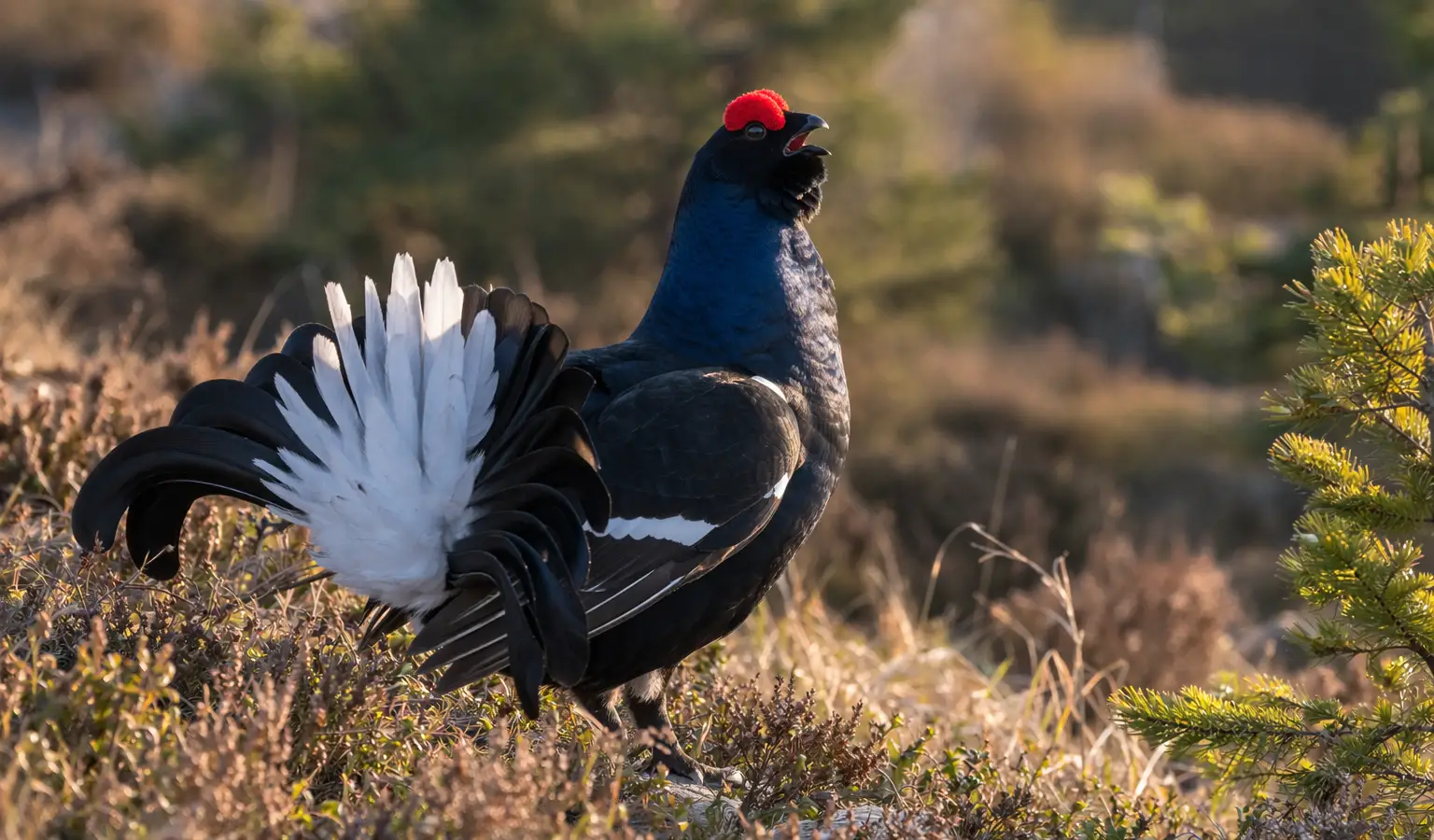
The black grouse is a medium-sized grouse, typically around 50 to 60 cm in length, with adults often weighing roughly 1.2 to 1.5 kg, though size varies by sex and region. It shows marked sexual dimorphism, which makes field identification easier during much of the year. The male is glossy black with a bluish sheen, contrasting white wing bars, white under-tail coverts, and a strongly lyre-shaped tail that is especially noticeable during display. Red combs above the eyes become conspicuous in the breeding season.
The female, often called a greyhen, is much more cryptic. She is mottled brown, barred and finely patterned, an adaptation that provides excellent camouflage among heather, grasses, bilberry, and rough ground vegetation. Her tail is not lyrate like the male's, and overall she resembles other grouse hens, so careful attention to habitat, size, and plumage pattern is useful.
In flight, black grouse appear broad-winged and powerful, with rapid wingbeats followed by short glides. Males are usually more striking at a distance because of the black-and-white contrast. On the ground, they often carry themselves with a compact, sturdy posture. Tracks, feathers, and droppings can be useful supporting signs where visual confirmation is brief.
Habitat and distribution
Habitat and distribution
Habitat
Black grouse favor a mosaic habitat rather than a single uniform vegetation type. The best biotopes usually combine open ground for display and feeding, low shrubs such as heather or bilberry for cover and forage, and nearby woodland edge or scattered trees for shelter. In many mountain and boreal landscapes, they are strongly linked to the ecotone between forest and open moor, as well as bog margins, rough pasture, regenerating clearings, and young conifer or mixed woodland with structural diversity.
They generally avoid dense, continuous closed-canopy forest with poor ground vegetation, and they also tend to do poorly in heavily simplified agricultural landscapes lacking cover. Hens with broods are especially dependent on areas rich in invertebrates, low vegetation, and secure concealment. Adult birds often need seasonal access to different habitat components, including spring display grounds, summer brood habitat, autumn feeding areas, and winter shelter.
Altitude varies by region. In some areas black grouse are associated mainly with uplands and mountain fringes, while elsewhere they occupy lowland bogs, heathlands, or forest moor systems. What matters most is habitat structure, food availability, and disturbance level rather than altitude alone.
Distribution
Lyrurus tetrix has a broad but fragmented distribution across parts of Europe and Asia. Its range extends from western and central Europe through northern and eastern forests and uplands into Russia and across parts of the Palearctic. Despite this large overall range, local occurrence can be highly uneven, with strongholds in some northern or mountainous regions and severe decline or disappearance in others.
In western Europe, black grouse populations have often contracted because of habitat loss, landscape fragmentation, changing forestry practices, infrastructure development, disturbance, and in some places high predation pressure. In Scandinavia and parts of the broader boreal zone, the species remains more widespread, although local population cycles and management concerns still matter.
At a local scale, black grouse are often distributed in pockets tied to suitable habitat mosaics. Their presence can therefore seem discontinuous even within apparently favorable country. For practical field use, distribution should always be interpreted through recent regional surveys, habitat condition, and current conservation status.
Lifestyle
Lifestyle and behaviour
Diet
The black grouse is an opportunistic omnivore with a diet that shifts by season, age, and local habitat. Adult birds feed heavily on plant material for much of the year, including buds, shoots, leaves, flowers, seeds, and berries. Heathland and forest-edge foods such as bilberry, crowberry, heather, and tree buds can be important where available.
In spring and winter, woody browse and buds often become more prominent, especially from birch and other shrubs or trees present in the bird's range. During late summer and autumn, berries and seeds may form a substantial share of the diet. Grit is also taken to help process fibrous food in the gizzard.
Chicks depend strongly on invertebrates during their early growth period. Insects and other small arthropods provide essential protein at a time when brood habitat quality can determine survival. This is one reason why black grouse need structurally varied ground vegetation: it must offer both cover and invertebrate-rich feeding conditions.
Behaviour
Black grouse are typically most active in the early morning and late afternoon, especially in areas where disturbance is limited. They spend much of their time feeding, resting, preening, and moving between cover and open patches. Their daily behavior is cautious, with frequent use of vantage points and rapid retreat into vegetation or away over the slope when alarmed.
Outside the breeding season, birds may be encountered in small groups, often feeding quietly along edges of moor, young forest, or rough clearings. In colder conditions they may conserve energy by limiting movement and choosing sheltered places. In snowy regions, winter behavior can include use of snow cover for insulation, although this varies with local conditions.
When flushed, black grouse usually erupt suddenly with strong wingbeats, sometimes after allowing a surprisingly close approach if cover is good. That abrupt takeoff is one reason they have long been considered difficult quarry where hunting remains legal. During the breeding period, male behavior changes dramatically: they become highly visible and vocal on leks, posturing, calling, and engaging in ritualized competition over access to females.
Social structure
Black grouse social organization changes through the year. Outside the breeding season they are often seen in loose small groups, sometimes segregated by sex, especially in winter or during periods of concentrated feeding. These groups are not rigid flocks in the way some open-country birds form large cohesive assemblies, but they do provide local social structure and shared use of feeding and resting areas.
The most characteristic social feature of the species is the lek system. In spring, males gather on traditional display grounds known as leks or lek arenas. There they advertise, posture, call, and compete for mating opportunities. A few dominant males may achieve a disproportionate share of matings, while other males remain peripheral or less successful.
Females visit leks to choose mates but do not form pair bonds with males for nesting or chick rearing. After mating, the hen nests alone, incubates the eggs, and leads the brood without male assistance. This separation between highly social male breeding display and solitary female parental care is central to black grouse ecology.
Migration
The black grouse is generally considered a resident or short-distance moving species rather than a true long-range migrant. Most populations make local or regional movements in response to snow conditions, food supply, disturbance, and seasonal habitat use. These shifts may involve altitudinal movement in mountain areas, with birds using different elevations according to weather and forage accessibility.
Juvenile dispersal can also influence local distribution, especially where habitat exists in scattered patches. Some birds move only short distances between breeding, feeding, and wintering areas, while others may range more broadly in severe seasons. Even so, black grouse usually remain tied to landscapes that provide the essential mix of cover and food.
For practical field interpretation, it is best to think of the species as locally mobile. Apparent absence from a site at one time of year does not always mean permanent abandonment; it may reflect seasonal movement within a broader home landscape.
Reproduction
Reproduction
The breeding cycle of the black grouse is centered on spring lekking. As days lengthen, males return to established display grounds and begin conspicuous courtship behavior. These display sites may be used for many years if habitat remains suitable and disturbance stays low. Females visit the lek, mate, and then move off to nest in concealed ground cover.
The nest is a shallow scrape on the ground, usually hidden among heather, grass, dwarf shrubs, or low edge vegetation. Clutch size can vary, but black grouse generally lay a moderate number of eggs typical of grouse. Incubation lasts roughly three to four weeks; around 25 days is a reasonable general figure. The hen alone incubates and later protects the chicks.
Black grouse chicks are precocial, leaving the nest soon after hatching and feeding themselves under the hen's guidance. Early brood survival depends heavily on weather, insect availability, and secure cover. Cold wet periods can be especially harmful. If conditions are favorable, young birds grow quickly through summer and gradually join wider seasonal social groups.
Field signs
Field signs
Field signs of black grouse can be subtle but useful when read alongside habitat. Tracks on soft ground, mud, snow, or damp peat are often among the best clues. They show the typical three-forward-toe pattern of a ground-dwelling bird, with size and stride reflecting a medium to large grouse. In snow, repeated use of feeding routes or sheltered resting areas can reveal regular movement corridors.
Feathers are another valuable sign. Molted body feathers or wing feathers may be found near roosting sites, feeding edges, dusting places, or locations where a predator has taken a bird. Male feathers are usually easier to recognize because of their darker coloration and stronger contrast. Droppings may accumulate in favored feeding or roosting zones and can help confirm recent presence, especially in winter.
Display grounds in spring can sometimes be identified by repeated male use of open patches on moorland or forest edge, often with feathers, droppings, and signs of concentrated activity. However, such places are highly sensitive, and close approach should be avoided during the breeding season. For practical observation, the most reliable approach is to combine habitat reading, early-morning listening, and careful scanning from a distance.
Ecology and relationships
Ecology and relationships
Ecological role
Black grouse play several roles within upland and forest-edge ecosystems. As consumers of buds, shoots, leaves, berries, seeds, and insects, they are part of both plant and invertebrate food webs. Their feeding can contribute modestly to seed dispersal, especially where berry-rich shrub communities are important, and chick foraging adds to local insect regulation.
They are also prey for a range of predators, including foxes and birds of prey, with eggs and chicks particularly vulnerable. In that sense, black grouse occupy a middle position in the food chain, transferring energy from vegetation and invertebrates to larger carnivores. Population outcomes often reflect the balance between habitat quality, weather, and predation pressure.
Perhaps their most important ecological significance is as a habitat-indicator species. Healthy black grouse populations often point to structurally diverse moorland and forest-edge systems with good ground vegetation, suitable brood habitat, and relatively low chronic disturbance. Their decline can therefore signal wider deterioration in upland habitat mosaics.
Human relationships
The relationship between people and black grouse is shaped by hunting heritage, habitat management, forestry, grazing practice, and wildlife observation. Historically, the species has been valued as a traditional upland game bird in parts of its range. Today, however, it is just as often discussed in the context of conservation, population recovery, and responsible access to sensitive breeding areas.
For birdwatchers and naturalists, black grouse leks are among the most celebrated spring wildlife spectacles in Europe, though observation must be conducted carefully to avoid disturbance. For land managers, the species can act as a practical benchmark for whether open woodland edges, heaths, and mountain mosaics are functioning well. For rural communities, it may be tied to local identity and upland cultural history.
Where black grouse remains legally huntable, harvest is usually conservative and highly dependent on local regulation and population assessment. In some places hunting has been reduced or stopped entirely because numbers are too low. This makes black grouse a species where field knowledge, restraint, and current legal awareness matter more than tradition alone.
As game, the bird is edible, but that fact is secondary to the broader management reality: sustainable use is only possible where populations are demonstrably robust. Health considerations in wild birds may include avian parasites and general condition linked to habitat and climate.
Legal framework and management
Legal framework and management
Legal status
Legal status for the black grouse varies widely by country, region, and sometimes by local management unit. In many parts of its range, hunting is strictly regulated, heavily limited, or prohibited altogether. Even where an open season exists, it may be short, quota-based, sex-specific, area-specific, or dependent on annual monitoring results. A general autumn season such as October to November may apply in some jurisdictions, but this should never be assumed without checking current local law.
The species is often subject to conservation concern because many populations are fragmented or declining. As a result, legal frameworks may include protected breeding areas, disturbance restrictions around leks, and habitat-focused management obligations. In some countries, black grouse also falls under broader bird conservation measures that influence access, harvest, and land use.
Anyone seeking to observe, manage, or hunt black grouse should consult the latest official regulations, regional game laws, protected area rules, and population advisories. With this species, legal compliance is inseparable from good wildlife practice.
Management tips
Good black grouse management starts with habitat structure. The species generally benefits from varied mosaics that include open display areas, shrub-rich cover, insect-rich brood habitat, and nearby woodland edge or scattered trees. Uniform forestry, overgrown closed canopy, excessive grazing, or complete scrub removal can all reduce habitat value if they simplify the landscape too far.
Disturbance management is especially important around lek sites and brood-rearing areas. Repeated human presence, poorly timed forestry work, uncontrolled recreational pressure, or infrastructure development can affect breeding success and site fidelity. In many landscapes, practical management means protecting traditional lek arenas, maintaining transitional vegetation, and ensuring that hens with chicks have access to warm, food-rich cover.
Predation pressure is often discussed in black grouse conservation, but predator issues should be considered within the wider context of habitat quality, weather, and local legal frameworks. Habitat alone will not solve every problem, yet poor habitat often magnifies all others. Monitoring through counts, lek surveys, brood observations, and sign-based field assessment is usually more informative than relying on assumptions.
- Prioritize habitat diversity: retain a mix of moor, young woodland, edge cover, and feeding plants.
- Protect breeding areas: limit disturbance during spring display and brood season.
- Use local data: management and any hunting decisions should follow current population trends, not tradition alone.
- Read the ground carefully: tracks, feathers, droppings, and repeated use of edge habitats often reveal more than chance sightings.
Fun facts
Fun facts
The black grouse is best known for the male's spectacular spring lek display, one of the classic wildlife sounds and sights of northern and upland landscapes. A traditional lek may be used for many years, sometimes becoming a cultural reference point for local naturalists and game managers alike.
The male's tail is not just decorative: its dramatic lyre shape is one of the clearest field marks behind the species' scientific and visual identity. In strong light, the black plumage can show a rich bluish gloss rather than appearing flat or dull.
Although often thought of as a mountain bird, black grouse are really specialists of habitat transition. In many regions, the key to finding them is not the highest ground, but the right mix of moor, scrub, rough vegetation, and forest edge.
Black grouse chicks depend heavily on insects in early life, so a bird famous for eating buds and berries also relies on healthy invertebrate-rich brood habitat. That small detail helps explain why weather and habitat quality are so critical to population success.