
American mink
Neovison vison
An introduced and invasive carnivore living along rivers and wetlands.
Type
Mammal
Lifespan
10 years
Hunting season
Toute l'année
Edible
No
Fact sheet
American mink
Scientific name
Neovison vison
Type
Mammal
Meat quality
-
Edible
No
Lifespan
10 years
Gestation
42 days
Size
35-45 cm
Weight
0,7-1,5 kg
Diet
Fish, amphibians, small mammals
Status
Huntable / controlled (invasive) depending on country
Hunting season
Toute l'année
Breeding season
4 / 5
Lifestyle and behaviour
Behaviour : Aquatic, nocturnal, aggressive
Social structure : Solitary and aggressive
Migration : Sedentary along waterways
Habitat
- Wetland
- River
Natural predators
- Birds of prey
- Otter
Hunting methods
- Trapping
Health risks
- Parasitic diseases
Ecosystem role
- Aquatic ecosystem imbalance
Introduction
General description
The American mink, Neovison vison, is a small semi-aquatic carnivorous mammal native to North America but introduced to many parts of Europe and other regions through escapes and releases from fur farming. In areas where it is not native, it is widely regarded as an invasive predator because it adapts quickly to rivers, marshes, ponds, drainage channels, and coastal wetlands, where it can exert heavy pressure on local wildlife.
Although compact in size, the American mink is an efficient and aggressive hunter. It combines the movement of a mustelid with strong swimming ability, allowing it to exploit fish, amphibians, waterbirds, small mammals, and eggs. This versatility is one reason the species has spread so successfully in suitable wetland and riparian habitat.
From a field ecology and management perspective, the species matters because it can alter aquatic and wetland communities, especially where prey species evolved without this predator or where native predators already face pressure. In hunting and control contexts, the American mink is most often associated with trapping and invasive predator management rather than with food use or traditional game harvest.
Morphology
Morphology
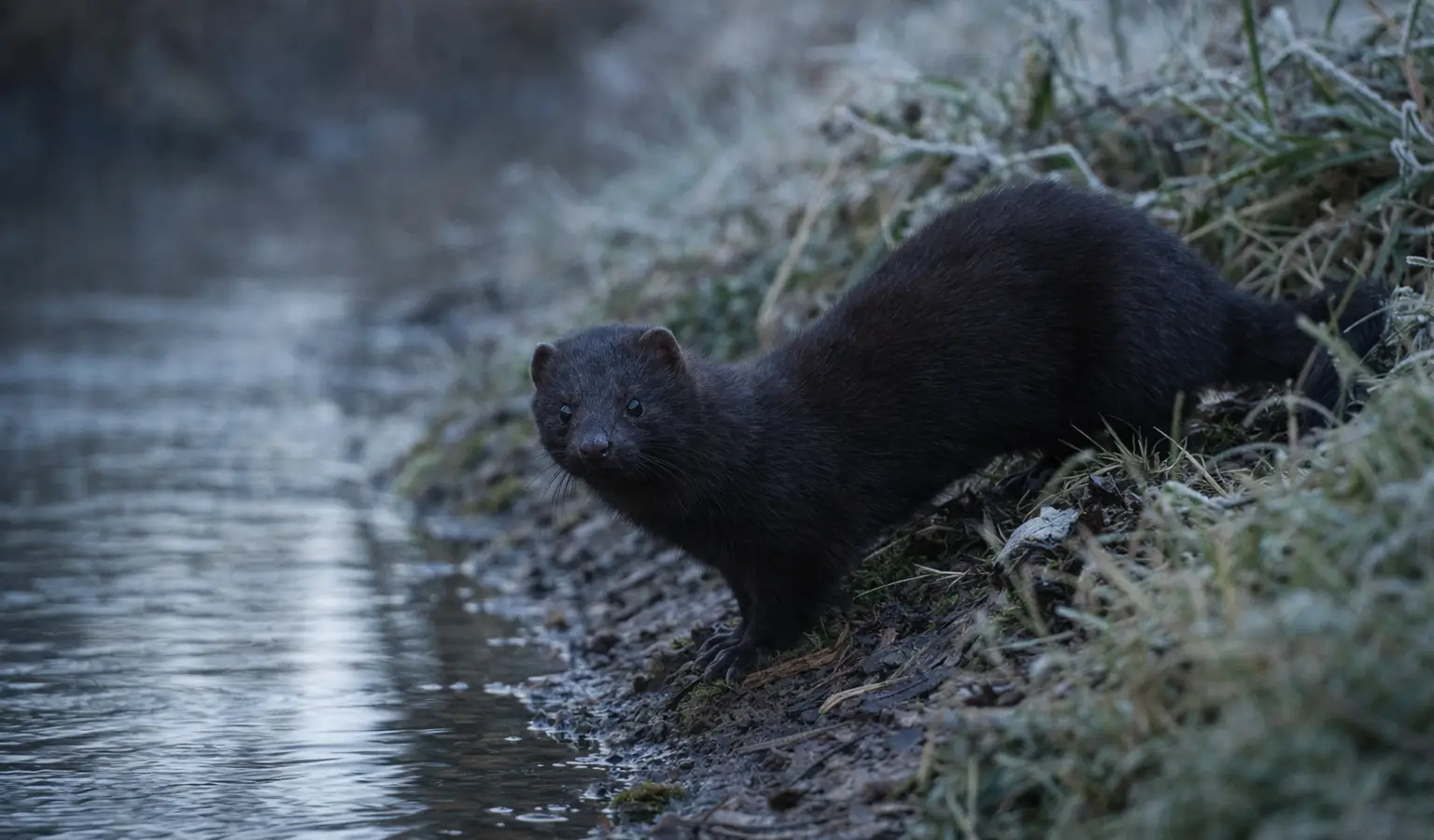
The American mink is a slender, low-slung mustelid with a long body, short legs, a relatively small head, rounded ears, and a moderately bushy tail. Adults commonly measure about 35 to 45 cm in body length, with additional tail length, and often weigh roughly 0.7 to 1.5 kg, though males are usually larger and heavier than females.
Its coat is typically dark brown to almost black, glossy when in good condition, with dense fur suited to cold water. A small white patch on the chin or throat is common, though markings vary. In the field, it can be confused with other semi-aquatic mammals, but it is much smaller and slimmer than an otter, more streamlined than a polecat in wet habitats, and usually shows a quick, fluid, bounding gait along banks.
Useful identification points include its low profile, sinuous movement, dark uniform coloration, and habit of slipping in and out of cover near water. When seen swimming, the body often rides low, with only part of the back and head visible.
Habitat and distribution
Habitat and distribution
Habitat
American mink prefer habitats with permanent or frequent access to water. Typical biotopes include rivers, streams, ditches, ponds, lakeshores, marshes, reedbeds, wet meadows, estuaries, and other wetlands with abundant edge cover. Bank structure matters: they often use sites with roots, stones, dense grass, brambles, driftwood, or cavities that provide concealment, resting places, and hunting opportunities.
The species is highly adaptable and can persist in both natural and human-modified environments. It often occupies agricultural lowlands, canal networks, fish-farm surroundings, and peri-urban wetlands if prey and shelter are available. Habitat quality tends to improve where waterways offer a mosaic of shallow margins, cover, and prey-rich feeding zones.
In practical terms, the best American mink habitat combines water, vegetative cover, prey availability, and secure bank-side refuges. Fragmented waterways may still be used if movement corridors remain intact.
Distribution
Neovison vison is native to much of North America. Outside its native range, American mink populations are established in several parts of Europe and in some other regions following historical introductions linked mainly to the fur trade.
Its local distribution is usually tied closely to river systems, wetland complexes, ponds, reservoirs, and coastal marshes. Presence can be patchy at fine scale, with occupancy influenced by prey density, cover, control pressure, and competition with other predators such as the otter. In some regions, recovering otter populations may reduce mink abundance locally, though outcomes vary with habitat and landscape context.
Because legal status and population trends differ by country, region, and management area, current distribution is best interpreted through local wildlife agencies, invasive species records, and basin-level monitoring rather than broad assumptions.
Lifestyle
Lifestyle and behaviour
Diet
The American mink is an opportunistic carnivore with a broad diet. Common prey includes fish, amphibians, small mammals, crayfish where present, aquatic invertebrates, birds, eggs, and occasionally carrion. Its feeding ecology is strongly shaped by what is easiest to catch in a given season and habitat.
Along streams and ponds, mink may focus on fish, frogs, and small waterside mammals. In marshes and nesting areas, they can prey heavily on ground-nesting birds, duck broods, and eggs. In colder periods, they may shift toward rodents, trapped fish in shallow margins, or whatever concentrated food source remains accessible.
This flexible diet is one reason the species can persist in varied landscapes and can create disproportionate predation pressure on vulnerable wildlife. Where prey populations are already stressed, even a relatively low density of mink may have noticeable ecological effects.
Behaviour
The American mink is typically solitary, secretive, and alert. It is often described as mainly nocturnal or crepuscular, but activity can occur at any hour, especially in quiet areas, during cool weather, or where food opportunities are concentrated. Individuals spend much of their time traveling along banks, inspecting cover, swimming short sections, and investigating holes, root tangles, and shoreline structure.
In movement, it alternates between a quick bounding gait on land and efficient swimming in water. It readily follows linear features such as river margins, drainage ditches, reed edges, and shorelines, using these as hunting routes and territorial travel corridors. When disturbed, it may dive, vanish into bank cover, or slip away with surprising speed rather than staying exposed.
American mink are often described as aggressive, particularly in feeding competition and territorial encounters. Their confidence around water, agility in dense cover, and tendency to keep moving make direct observation brief unless conditions are calm and the observer remains concealed.
Social structure
American mink are generally solitary outside the breeding period. Adults maintain individual home ranges centered on productive sections of water, bank cover, and resting sites. Males usually range over larger areas than females, and overlap patterns depend on habitat quality, population density, and season.
Interactions between adults are limited and can be aggressive, especially where resources are concentrated. Scent marking plays an important role in spacing and communication. In practical terms, repeated use of the same river section does not necessarily indicate a social group; it may reflect overlapping travel routes or sequential use by different individuals.
Females rear young alone. Once juveniles become independent, they disperse and establish their own territories where habitat is available.
Migration
The American mink is not a migratory mammal. It is best described as sedentary along waterways, with regular local movement inside a home range rather than seasonal long-distance migration.
That said, dispersal can be significant, especially for juveniles seeking vacant territory. These movements usually follow rivers, canals, wetland chains, and other connected aquatic corridors. In fragmented landscapes, drainage systems and riparian strips can function as effective routes of expansion.
Seasonal shifts in space use may still occur. During breeding, dispersal, flood events, freezing conditions, or changes in prey concentration, individuals may travel more widely than usual, but this should not be confused with true migration.
Reproduction
Reproduction
Breeding usually occurs in late winter to early spring, though exact timing varies with latitude and climate. The reported gestation period is around 42 days, but in mustelids reproductive timing can be biologically complex, and local sources may report some variation. Litters are born in a concealed den, often in a bank cavity, under roots, in rock crevices, or in abandoned burrows.
Litter size can vary, but several kits are commonly produced. The young are born blind and helpless, depend entirely on the female at first, and remain in the den until they are developed enough to follow her on short foraging movements. Through summer, juveniles learn to hunt and use cover along the water's edge.
By late summer or autumn, many young mink begin dispersing, which is an important phase for colonization of new waterways and for the spread of local populations.
Field signs
Field signs
Field signs of American mink are often subtle and easiest to find along muddy banks, sand margins, culverts, bridge edges, reed lines, and livestock drink points. Tracks are small mustelid prints with five toes, though not all toes always register clearly. The gait often appears as paired or staggered bounds following the water's edge.
Droppings are typically dark, twisted, and tapered, often left on prominent features such as stones, logs, grass tussocks, or bank junctions used as scent-marking points. They may contain fish scales, fur, feathers, bone fragments, or amphibian remains, depending on diet. A musky odor can sometimes be noticeable at fresh marking sites.
Other signs include prey remains at sheltered feeding points, repeated use of holes in banks, slides into water, and narrow shoreline trails through cover. Distinguishing mink signs from those of polecat, stoat, or otter requires caution, especially where several mustelids use the same corridor.
Ecology and relationships
Ecology and relationships
Ecological role
In its native range, the American mink is a normal mid-sized predator within wetland and riparian food webs. In introduced areas, however, it often functions as an invasive mesopredator capable of disrupting local ecological balance. Its impact may include predation on waterbirds, amphibians, fish, and small mammals, especially in sensitive island, marsh, or riverine systems.
The species can also influence the behavior of prey through constant shoreline hunting pressure. Because it uses both aquatic and terrestrial resources, it links food-web processes across habitat boundaries. Where native fauna are not well adapted to this predator, or where breeding sites are concentrated and exposed, effects can be severe.
At the same time, American mink can become prey for larger predators such as birds of prey and, in some contexts, may be displaced or suppressed by otters. Even so, in many invaded landscapes it remains a significant management concern.
Human relationships
The relationship between people and the American mink is shaped largely by its history in the fur industry and by its current status as an introduced predator in many countries. Escapes and releases from captivity played a major role in establishment outside the native range. Today, the species is more often discussed in terms of invasive species control, wetland conservation, fishery concerns, and protection of vulnerable birds than as a valued wild resource.
For land managers, farmers, fishery operators, and conservation practitioners, mink can create conflict where they prey on stocked fish, domestic fowl, or sensitive wildlife populations. For naturalists, they are an interesting but often elusive mammal to observe, usually seen only briefly at dawn, dusk, or along quiet banks.
In hunting culture, the species is most closely associated with trapping and predator management rather than with edible use, and it is generally not considered a food species. Handling carcasses or signs should be done with basic hygiene because wild mustelids can carry parasites and other pathogens.
Legal framework and management
Legal framework and management
Legal status
Legal status varies markedly by country and sometimes by region. In some jurisdictions, the American mink is classed as an invasive alien species and may be controlled or trapped year-round. In others, it may be listed under specific hunting, pest control, trapping, animal welfare, transport, or invasive species regulations.
Because rules can differ on permitted methods, trap types, dispatch requirements, closed areas, ownership of captured animals, and reporting obligations, anyone involved in management should always consult current local law before acting. This is especially important near protected wetlands, nature reserves, and areas where non-target species such as otters are present.
Legal interpretation should therefore be local and current, not assumed from the species name alone.
Management tips
Effective American mink management begins with careful reading of the habitat. Priority areas often include nesting wetlands, islands, fish-rich ponds, marsh edges, culverts, ditch junctions, bridge crossings, and narrow bank corridors that concentrate movement. Look for repeated travel lines, scent-marking points, and sheltered feeding spots rather than searching randomly across the whole waterbody.
Where control is legal and justified, consistency usually matters more than occasional effort. Monitoring should be repeated across seasons, especially in spring and late summer when breeding activity, juvenile dispersal, or prey vulnerability can increase management importance. In areas with otters or other protected species, species identification and non-target risk reduction are essential.
- Check muddy margins after rain for fresh tracks and travel direction.
- Inspect stones, logs, and culvert mouths for droppings and scent marks.
- Focus on connected waterways, because recolonization can occur quickly.
- Coordinate action at catchment scale when possible rather than on isolated sites.
- Use strict hygiene when handling carcasses or contaminated equipment because of parasitic disease risk.
In conservation-sensitive landscapes, management is usually most effective when combined with broader wetland monitoring and clear local legal compliance.
Fun facts
Fun facts
The American mink is one of the few small carnivores equally comfortable hunting along the bank and in the water, which gives it an unusually broad prey spectrum for its size.
Despite its modest body length, it can have an outsized ecological impact because it is stealthy, adaptable, and willing to exploit nests, burrows, shallow water, and dense bank cover in the same patrol.
Its scientific name was long widely given as Mustela vison, but modern taxonomy commonly uses Neovison vison, a detail that often appears in wildlife guides, field records, and older management literature.