
Alpine marmot
Marmota marmota
A mountain rodent living in colonies and hibernating through winter.
Type
Rodent
Lifespan
15 years
Hunting season
May – August
Edible
Yes
Fact sheet
Alpine marmot
Scientific name
Marmota marmota
Type
Rodent
Meat quality
Lean meat
Edible
Yes
Lifespan
15 years
Gestation
32 days
Size
50-60 cm
Weight
4-6 kg
Diet
Herbivore: grasses, roots, seeds
Status
Huntable depending on local rules
Hunting season
May – August
Breeding season
5 / 6
Lifestyle and behaviour
Behaviour : Burrowing, diurnal, alarm whistles
Social structure : Family colonies
Migration : Sedentary, hibernates in winter
Habitat
- Grassland
- Mountain
Natural predators
- Fox
- Chamois
Hunting methods
- Stalking
- Long distance shooting
Health risks
- Ovine plague
- Avian parasites
Ecosystem role
- Seed dispersal
- Soil aeration
Signs of presence
- Burrows
- Droppings
- Calls
Introduction
General description
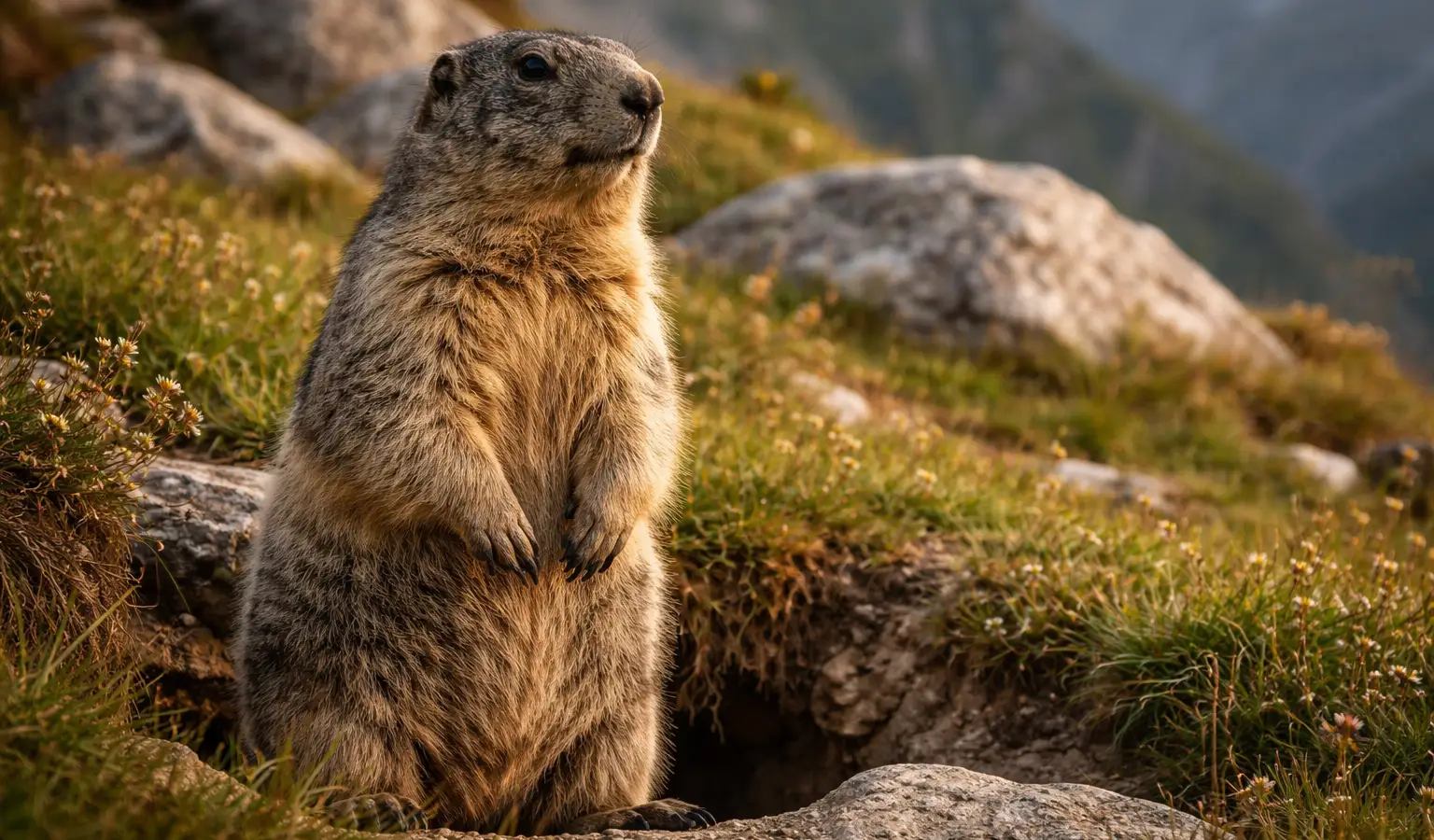
The Alpine marmot, Marmota marmota, is a large mountain-dwelling ground squirrel and one of the most recognizable rodents of the European highlands. Stocky, social, and strongly tied to alpine grassland, it lives in burrow systems above the forest line or along open mountain slopes where visibility is good and soil allows digging. It is best known for its upright posture, loud alarm whistle, and long winter hibernation.
In ecological terms, the Alpine marmot is more than a familiar alpine animal. Its burrowing alters soil structure, influences plant communities, and creates shelter opportunities for other organisms. As a grazing herbivore, it helps shape patches of mountain vegetation, while as prey it supports upland predator communities. In many mountain regions, it is also an important indicator species for open alpine habitat quality, snow conditions, disturbance, and seasonal productivity.
From a field and hunting perspective, the Alpine marmot is a species that demands careful observation rather than chance encounters. It is most often located by scanning sunny slopes for movement near burrow entrances or by listening for alarm calls. Where legal hunting exists, it is generally associated with selective mountain stalking and long-range observation rather than driven methods. Because populations, traditions, and regulations vary significantly between alpine regions, the species sits at the intersection of wildlife observation, local game culture, and sensitive mountain management.
Morphology
Morphology
The Alpine marmot is a robust rodent with a broad body, short neck, rounded ears, strong digging forelimbs, and a relatively short but bushy tail. Adults typically measure about 50 to 60 cm in body length and commonly weigh around 4 to 6 kg, although seasonal body mass can fluctuate considerably before and after hibernation. The head appears blunt, the muzzle is short, and the feet carry powerful claws adapted for excavation.
Coat color is generally a mix of grizzled brown, gray-brown, and buff tones, often with a slightly paler belly and a darker tail tip. In the field, its low, heavy profile, waddling gait, and habit of sitting upright near burrows are often enough for identification. Compared with smaller ground-dwelling rodents, the Alpine marmot looks compact and muscular rather than slender. Juveniles resemble adults but are smaller, softer-coated, and often stay close to the family burrow system.
Habitat and distribution
Habitat and distribution
Habitat
Marmota marmota is primarily associated with open mountain grassland, alpine meadows, subalpine pastures, and sunny slopes where deep enough soils allow stable burrow construction. It usually favors areas with a combination of short herbaceous vegetation for feeding, nearby lookout points, and well-drained ground that does not remain waterlogged through the season. Colonies are often established in places offering both food and visibility, since early predator detection is central to survival.
Typical biotopes include slopes above or near the upper forest limit, glacial valleys with grass cover, pasture mosaics, and high meadows broken by rocks or earth banks. The species may also use human-shaped mountain landscapes such as old grazing areas, ski-adjacent grassland, or pastoral zones, provided disturbance is not excessive and burrowing conditions remain suitable. Snow cover, slope exposure, and local climate strongly influence site quality because hibernation success depends on stable underground refuge conditions.
Distribution
The Alpine marmot is native to major mountain systems of central and southern Europe, especially the Alps, and it also occurs in parts of other upland regions where native or reintroduced populations are established. Its distribution is closely linked to suitable high-altitude open habitat rather than broad lowland landscapes. Within mountain ranges, occurrence can be patchy, shaped by elevation, terrain, snow regime, land use, and historical population continuity.
In many areas, the species is common enough to be a characteristic element of alpine fauna, but local abundance can vary greatly from valley to valley. Some populations occupy extensive connected habitat, while others are more isolated on suitable slopes and plateaus. Because mountain wildlife management differs by country and region, readers should treat distribution and local status as context-dependent rather than uniform across the species' entire range.
Lifestyle
Lifestyle and behaviour
Diet
The Alpine marmot is an herbivore that feeds mainly on grasses, forbs, roots, shoots, seeds, and other nutritious alpine plants. It takes advantage of the short mountain growing season by feeding intensively during spring and summer, when fresh vegetation is available and body fat must be rebuilt ahead of hibernation. Plant choice often reflects both local botanical composition and seasonal quality, with tender green growth generally preferred when accessible.
During the productive months, marmots may crop low vegetation close to burrows and along regular feeding routes, but they also range across nearby meadow patches to exploit changing plant availability. In late summer, accumulating energy reserves becomes especially important. Their feeding pressure is usually localized around colony areas, where repeated grazing can create visibly short swards and distinct foraging zones. Seasonal diet details vary by altitude, exposure, and plant community, but the overall pattern remains that of a selective mountain herbivore adapted to a very compressed feeding season.
Behaviour
Alpine marmots are mainly diurnal and are easiest to observe during calm, bright periods when they emerge to bask, feed, groom, or monitor their surroundings. A defining feature of their behavior is vigilance. Individuals frequently pause, stand upright, and scan the slope, especially near burrow mouths. If danger is detected, they give sharp alarm whistles and retreat rapidly underground.
The species is strongly burrowing and spends much of its life within a network of tunnels used for shelter, breeding, and hibernation. Daily activity is often structured around weather and disturbance. Cool mornings and stable sunny conditions may favor above-ground feeding, whereas intense heat, heavy rain, or repeated human pressure can reduce visible activity. Escape behavior is usually direct and efficient: marmots run low to the ground toward the nearest entrance rather than relying on concealment. This makes terrain reading, wind, movement control, and long periods of patient observation especially important for anyone studying or legally hunting the species.
Social structure
The Alpine marmot typically lives in family colonies centered on a shared burrow complex. A colony often includes a dominant breeding pair and offspring from one or more recent years, though exact group structure can vary with local conditions and population density. Social life is important in this species, and close spacing around burrow systems helps with vigilance, territorial defense, and maintenance of underground shelters.
Within the colony, individuals use calls, scent, posture, and physical contact to maintain cohesion and hierarchy. Social grooming, close resting, and cooperative alertness are all characteristic behaviors. Territory is generally organized around feeding ground and key burrow entrances, and neighboring groups may maintain clear spatial boundaries. Young animals eventually disperse to establish or join other colony areas, but the species is not a broad-ranging wanderer in the way some small game species can be.
Migration
The Alpine marmot is essentially sedentary. It does not undertake true migration, and most individuals remain closely tied to a colony territory and its burrow system throughout the active season. The most important annual movement pattern is not geographic migration but the shift between above-ground summer activity and prolonged underground winter hibernation.
Juvenile or subadult dispersal does occur, especially when young animals leave the natal colony to seek breeding opportunities elsewhere, but these movements are generally limited in scale compared with migratory game species. Seasonal space use can also contract or expand slightly depending on snowmelt, forage distribution, and disturbance, yet the species remains fundamentally local in its movement ecology.
Reproduction
Reproduction
Breeding in Marmota marmota is closely tied to the alpine seasonal cycle and the constraints imposed by long hibernation. Mating generally occurs soon after emergence from winter dormancy, when adults regain activity and begin using the colony range again. With a gestation period of about 32 days, young are born underground in the safety of the breeding chamber.
Litter size can vary, but several pups may be produced in favorable years. The young remain below ground for an initial period before appearing near the burrow entrance later in the season, when they can often be seen under close supervision by adults. Because the window for growth and fat accumulation is short at high altitude, successful reproduction depends heavily on spring timing, plant productivity, weather stability, and colony security. Not all adults necessarily breed every year, particularly where social hierarchy or environmental conditions limit reproductive success.
Field signs
Field signs
The most obvious sign of Alpine marmot presence is the burrow system. Look for multiple entrances on sunny alpine slopes, often with fresh spoil, worn edges, and short vegetation nearby. Entrances may be linked to lookout mounds, feeding patches, or paths between holes. Active colonies often show a clear concentration of openings rather than a single isolated den.
Droppings may be found near feeding areas, along frequently used routes, or close to burrow entrances. Repeated use can create visible runs through low vegetation, especially where animals move between feeding spots and cover. Perhaps the most distinctive field sign is auditory rather than physical: the sharp alarm call that carries across open mountain terrain and often reveals a colony before the animals themselves are seen.
Tracks can occur in soft soil around entrances, but in rocky alpine ground they are often less useful than burrow distribution, cropped vegetation, and behavior-based detection. For practical field observation, a combination of optics, patient slope scanning, and listening for whistles is usually more productive than searching for fine spoor alone.
Ecology and relationships
Ecology and relationships
Ecological role
The Alpine marmot plays a meaningful role in mountain ecosystems. As a grazing herbivore, it influences vegetation structure and can contribute to patchiness in alpine meadows through repeated feeding near colony sites. As a burrower, it promotes soil aeration, mixes organic and mineral layers, and affects drainage and microhabitat conditions. These physical changes can influence plant establishment and create ecological diversity at a small scale.
The species may also contribute to seed dispersal indirectly through foraging activity and soil disturbance. Its burrows can offer shelter, temporary refuge, or modified habitat conditions for invertebrates and other small animals. In the food web, Alpine marmots are prey for upland predators; foxes are plausible local predators, while the exact predator community varies by region and elevation. Their presence therefore links plant dynamics, soil processes, and predator-prey relationships in alpine landscapes.
Human relationships
People often encounter Alpine marmots as one of the most memorable mammals of the high mountains. They are popular with hikers, wildlife watchers, photographers, and naturalists because they are vocal, visible in open terrain, and strongly associated with classic alpine scenery. At the same time, their burrowing can occasionally create friction in heavily managed pasture, infrastructure margins, or erosion-sensitive slopes, although the significance of that impact depends greatly on local context.
In hunting culture, where the species is legally classified as game, the Alpine marmot is generally treated as a specialized mountain quarry rather than a routine small game species. Hunting relevance centers on fieldcraft, careful species identification, distance judgment, and respect for terrain, season, and colony structure. The species is also edible, and in some regions it has historical culinary or traditional significance. Management conversations may additionally involve disease surveillance, local conservation goals, and the balance between hunting, tourism, grazing, and alpine habitat use.
Legal framework and management
Legal framework and management
Legal status
The legal status of the Alpine marmot varies by country, region, and local game law. In some areas it is huntable under defined rules, while in others it may be protected, tightly regulated, or managed through specific quotas and seasonal frameworks. The status provided here is best understood as huntable depending on local rules, not as a universal entitlement to harvest.
Where hunting is permitted, regulations may cover season dates, authorized methods, permits, bag limits, weapon restrictions, and protected zones such as parks or reserves. The season information provided for this profile indicates a general period of May to August, but actual opening and closing dates can differ significantly. Anyone observing, managing, or hunting Alpine marmot should verify current official regulations with the competent local authority before entering the field.
Management tips
Good Alpine marmot management starts with habitat reading. Productive colony areas usually combine open visibility, stable burrowing ground, moderate grazing pressure, and a dependable supply of herbaceous forage during the short mountain season. Maintaining a mosaic of suitable alpine grassland and limiting unnecessary disturbance around key colony sites can support stable local occupancy.
- Assess colony activity by combining visual counts, burrow mapping, and repeated observation at different times of day.
- Be cautious about interpreting absence from a single visit; weather, tourist pressure, and seasonal timing can greatly affect above-ground activity.
- Where hunting is legal, avoid excessive pressure on small or isolated colonies and take local recruitment into account.
- In management planning, consider disease monitoring, predation context, snow conditions, and the effects of pasture use or infrastructure development on burrow stability.
- Use a regional approach: alpine populations can differ sharply in density, accessibility, and resilience.
For observers and hunters alike, patience matters. Distant glassing from a stable vantage point is usually more effective and less disruptive than repeated close approach. In steep mountain terrain, safety, shot ethics, retrieval practicality, and legal certainty should always come before opportunity.
Fun facts
Fun facts
The Alpine marmot is one of the classic hibernators of Europe, spending a remarkably long part of the year underground in winter dormancy. To survive that period, it must build substantial fat reserves during the short alpine summer.
Its alarm whistle is so characteristic that many people hear a marmot before they ever see one. On open slopes, a single warning call can send an entire colony racing back to cover.
Although often casually described as a simple mountain rodent, Marmota marmota is a highly social, climate-sensitive alpine specialist whose yearly cycle is tightly synchronized with snow, plant growth, and the narrow seasonal window of life above ground.